
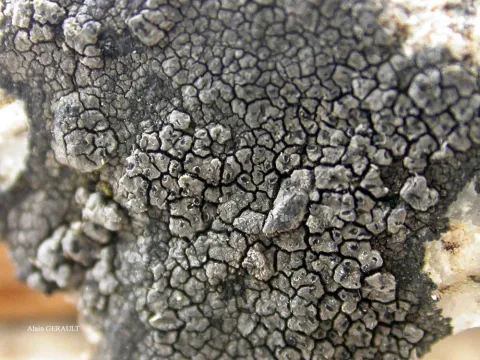
Schaereria fuscocinerea
Schaereria fuscocinerea
Schaereria fuscocinerea is a crustose lichen known for colonizing rock surfaces and concrete infrastructures.
What the section contains
Schaereria fuscocinerea
In an agricultural context, it is not a traditional crop pathogen but is recognized as a biological agent of surface erosion.
The organism is a symbiotic association between a fungus and an alga, perfectly adapted to harsh, nutrient-poor environments.
It acts as a pioneer species on inorganic substrates, slowly altering the mineral surface through biochemical and physical means.
As a result, it is often treated as a biological factor that can lead to the structural degradation of agricultural buildings or walls.
The lichen appears as a crust-like, cracked thallus, typically displaying colors ranging from brown to ash-grey.
A distinctive characteristic is the presence of apothecia, which are small, dark fruiting bodies scattered across the thallus surface.
The growth pattern often highlights micro-fractures in the substrate, making the colonized area appear rugged and weathered.
Under moist conditions, the lichen may change in vibrancy, allowing for easier detection on stone or concrete foundations.
Over time, the colonies can fuse together to cover large surface areas, creating a mosaic of textures.
Schaereria fuscocinerea prefers stable, solid substrates and requires significant sunlight to carry out its photosynthetic processes.
It exhibits high resistance to extreme temperature fluctuations, allowing it to survive in varied climatic conditions.
Adequate moisture levels are crucial for its metabolic activity, although it remains dormant during periods of drought.
The species thrives in environments where airborne spores can easily settle into porous or damaged surface areas.
It is generally sensitive to high levels of air pollution, which can limit its natural colonization in industrial zones.
The primary concern is the physical and chemical degradation of materials, known as biocorrosion, which compromises structural integrity.
Lichen acids produced by the fungus slowly leach minerals from the stone, accelerating the weathering process of the structure.
The accumulation of biomass under the lichen creates a moisture trap, facilitating the growth of other organisms and promoting rot.
Visually, the presence of these colonies on agricultural buildings can lead to aesthetic deterioration and perceptions of poor maintenance.
Preventative cleaning and structural repairs are often necessary to mitigate these impacts over the lifespan of the construction.
Mechanical removal through scrubbing or high-pressure water blasting is the most immediate way to clear affected surfaces.
Chemical control involving biocide treatments can prevent the re-establishment of spores on the cleaned areas.
Applying water-repellent sealants to concrete or stone surfaces reduces the moisture availability required for lichen growth.
Routine maintenance, including sealing small cracks and cleaning surfaces, is essential for long-term prevention.
- Monitor structures for early signs of colonization.
- Use smooth, non-porous finish materials for construction.
- Ensure adequate drainage to prevent constant surface dampness.