
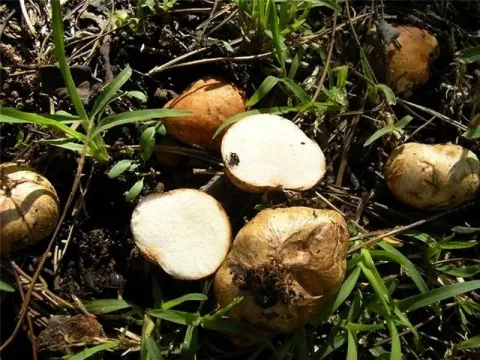
Rhizopogon fungi
Rhizopogonaceae
The presence of Rhizopogon fungi is often manifested by the appearance of tuber-like fruiting bodies found partially or fully buried in the soil or forest litter layer.
What the section contains
Rhizopogon fungi
A distinctive sign of their activity is the development of thick, white, or yellowish mycelial strands that form a dense sheath around the tree root systems.
Unlike pathogenic infections, these fungal structures do not cause necrosis, discoloration, or tissue decay in the roots, which remain firm and healthy.
Under moist conditions, a faint mushroom-like odor may be detected near the base of the trees where the fungi are active, indicating the development of spores.
Diagnosis confirms that the root system shows enhanced branching rather than signs of root rot, verifying the beneficial symbiotic nature of the organism.
Rhizopogonaceae is a family of basidiomycete fungi within the order Boletales, which are primarily known for their obligate symbiotic relationships with coniferous trees.
They establish an ectomycorrhizal association, where the fungus surrounds the root tip and penetrates the intercellular spaces of the cortex, forming the Hartig net.
Biologically, these fungi are not pathogens; they are essential mutualistic organisms that facilitate nutrient and water exchange between the soil and the tree.
The fungus reproduces through spores, which are distributed via soil movement, small mammals, or groundwater, establishing new colonies near susceptible host roots.
In the forestry sector, they are classified as beneficial mycorrhizal fungi, vital for the survival and growth of pine, fir, and spruce plantations.
Rhizopogon species thrive in forest soils rich in organic matter and acidic conditions, which are typical for coniferous ecosystems.
Optimal development occurs during the growing season when temperatures are moderate and soil moisture is consistent but not saturated.
The presence of root exudates, specifically carbohydrates and amino acids, is a primary driver for the germination and colonization of the fungus on tree roots.
High tree density within a forest stand encourages the expansion of the common mycorrhizal network, allowing the fungus to colonize various trees throughout the area.
Significant shifts in soil pH or extreme long-term drought can inhibit the growth of the fungal mycelium and reduce the efficiency of the symbiosis.
Rhizopogon fungi do not cause damage to plants and are not considered plant diseases; rather, they are beneficial components of forest biology.
The misconception of them being harmful arises when their fungal structures are wrongly identified as pathogenic root rot organisms by non-specialists.
On the contrary, the absence of these fungi in the soil can lead to stunted growth and poor survival rates in young nursery seedlings, representing a loss rather than a gain.
No harm is reported from the presence of these fungi even in high density; they serve as a protective barrier against soil-borne pathogens by occupying root surface niches.
They pose no threat to agricultural crops as they are strictly specialized for woody tree hosts and do not interfere with annual or perennial garden plants.
No control measures are necessary for Rhizopogon fungi, as they are not pathogens and play a critical role in maintaining tree health.
In forestry practice, nursery managers actively promote their presence by inoculating planting substrates with spores to enhance seedling development.
The application of fungicides in areas where these beneficial fungi are present is highly discouraged, as it disrupts the natural mycorrhizal balance.
Manual removal of fruiting bodies may be performed solely for aesthetic reasons in landscaped areas, but it has no impact on the underground fungal colony.
Best practices focus on maintaining soil health and preventing excessive disturbance to the root zones of trees to foster healthy mycorrhizal ecosystems.