
Raspberry leaf curl
Raspberry leaf
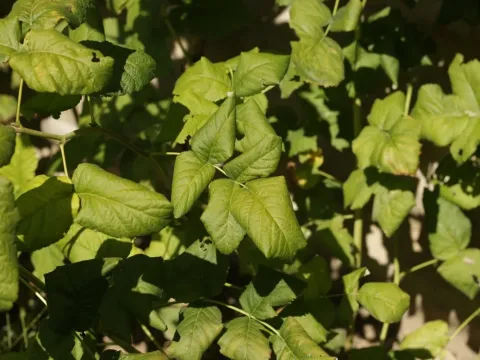
The primary external symptom of the disease is the deformation of the leaf blade. Leaves become small, puckered, and their margins curl downwards, resulting in a characteristic "curly" appearance.
What the section contains
Raspberry leaf curl
The color of the foliage gradually changes from a healthy green to a dark green with a bronze or glassy tint. The leaf surface becomes uneven, and premature shedding of the affected leaves is frequently observed.
Canes infected with the virus show reduced growth vigor. They become stunted, brittle, and develop an arched or distorted shape, which hinders the transport of nutrients throughout the plant.
Berries on infected bushes develop very poorly. They become small, dry, lose their typical varietal flavor, and often wither directly on the pedicels without reaching maturity.
The root system of the plants also undergoes degradation. Over the course of a few years, the bush completely loses productivity and eventually dies without producing viable new shoots.
The causative agent of the disease is the Raspberry leaf curl virus (RLCV). This is a pathogenic virus that infects exclusively species of the Rubus genus, including red raspberry.
The virus spreads systemically, infiltrating all plant tissues, including roots, stems, and fruits. It does not survive in soil or plant debris, requiring a living host organism to maintain its life cycle.
The primary vector of the infection in nature is the small raspberry aphid (Aphis rubicola). The insect acquires the virus while feeding on the sap of an infected bush and transmits it to healthy plants.
Transmission can also occur through the use of poor-quality nursery stock. If a seedling is taken from an infected mother plant, the disease will manifest shortly after planting.
The incubation period of the virus can range from a few weeks to several months, during which external symptoms may not be visible, yet the plant already acts as a source of infection.
The development of the disease is directly dependent on the population density of the small raspberry aphid. The higher the pest pressure, the faster the virus spreads throughout the raspberry patch.
Warm and dry weather promotes the active reproduction of the virus vector. During periods of mass aphid flight, the risk of infecting healthy plantings increases significantly.
Lack of proper maintenance, such as the presence of weeds, creates a favorable environment for pests that act as reservoirs for the virus.
Overcrowded plantings hinder proper air circulation, creating a microclimate that is comfortable for aphid colonization and accelerates the processes of infection transmission.
Improper agricultural practices that weaken plant immunity make raspberries more susceptible to viral infections and accelerate the degradation of the bushes.
Raspberry leaf curl is one of the most dangerous raspberry diseases, as viral pathogens cannot be cured with chemical fungicides.
The damage manifests in a catastrophic reduction in yield. Most berries fail to set or drop off before reaching full maturity, rendering them unsuitable for harvest.
Eventually, the entire plantation may succumb to the infection. Infected bushes stop producing high-quality suckers, making further propagation of the variety impossible.
Economic losses are tied to the necessity of completely removing the raspberry patch. Infected plants must be dug up and destroyed immediately to protect neighboring areas.
The disease leads to the degeneration of the cultivar. Over time, the quality characteristics of the raspberry are lost, and the land becomes unsuitable for productive berry cultivation.
The primary method of control is strict adherence to quarantine measures. Upon detecting symptoms, the infected bush must be immediately dug up, including the roots, and burned off-site.
Using only healthy, certified planting material from professional nurseries is the most effective way to prevent the introduction of the virus.
Consistent control of the small raspberry aphid is essential. The use of insecticides against the virus vectors during their migration periods significantly lowers the risk of spreading the disease.
Cultural practices, such as thinning the rows and weeding, allow for the creation of conditions that are unfavorable for aphid habitation in the raspberry patch.
Proper fertilization and irrigation boost the overall vigor of the plants, allowing them to better withstand viral stress, although these measures cannot cure an already infected plant.