
Raspberry rust
Phragmidium rubi-idaei
The causative agent of the disease is the specialized fungus Phragmidium rubi-idaei. It is an obligate parasite belonging to the group of rust fungi that affect exclusively plants of the genus Rubus (raspberry).
What the section contains
Raspberry rust
The pathogen's life cycle includes the formation of several types of spores, allowing it to survive successfully under various conditions. The fungus persists as spores on fallen infected leaves and within the tissues of infected canes.
The infection is highly adapted to its host, utilizing the plant's nutrients for its growth and sporulation. The parasite penetrates the epidermis of the plant, forming characteristic pustules (aecia and uredinia).
A particular danger is the fungus's ability to spread rapidly via wind and rain droplets. The overwintering stage (teliospores) ensures the pathogen's survival during harsh winter conditions.
Infection affects all above-ground parts of the plant, including leaves, petioles, and annual canes, making management a complex task for agronomists.
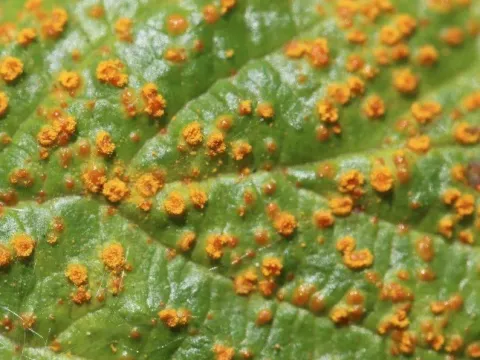
The first signs of raspberry rust appear in spring as small yellow or orange spots on the upper side of the leaves. This is the initial stage of fungal sporulation.
As the disease progresses, larger, raised pustules of brown or dark rust color, containing spores, form on the underside of the leaf.
In cases of severe infection, deep cankers appear on the canes, which can girdle the stem, causing deformation and subsequent drying out.
Leaves begin to yellow prematurely, curl, and drop, which disrupts the photosynthesis process and weakens the entire plant before winter.
- Yellowing and dropping of foliage.
- Presence of orange spots (pustules) on leaves.
- Appearance of cankers on raspberry canes.
- Deformation and drying of young shoots.
The development of Phragmidium rubi-idaei is facilitated by high humidity, especially during prolonged rainy periods and heavy nightly dew.
The optimal temperature range for spore germination is +18...+22°C. Under these conditions, the incubation period is shortened, leading to rapid disease spread.
Dense raspberry plantings create stagnant, humid air pockets, significantly increasing the risk of infection spreading from diseased plants to healthy ones.
Poorly ventilated areas and lack of proper agrotechnical maintenance contribute to the accumulation of the infection background in the soil and on plant debris.
Excessive application of nitrogen fertilizers, which triggers rapid growth of soft tissues, also makes plants more susceptible to fungal pathogen penetration.
Raspberry rust causes significant economic damage, reducing berry yields by 30–50% in epiphytotic years.
Due to premature leaf drop, bushes fail to store enough carbohydrates and nutrients to prepare for dormancy.
Damaged canes become extremely brittle, breaking under the weight of the crop or strong winds, leading to the loss of fruiting branches.
Berry quality decreases sharply: they become small, acidic, and lose their marketability, making them unsuitable for commercial sale.
Severe infestation can lead to total bush death within 2–3 years, as the plant loses its natural immunity and becomes sensitive to other pathogens.
The basis of control is agrotechnics: mandatory collection and destruction (burning) of fallen leaves and infected canes in autumn.
It is important to follow proper spacing to ensure good airflow between rows and to prune raspberries regularly to reduce canopy humidity.
The use of chemical protective agents, such as copper-based fungicides or systemic products, is effective during the early stages of symptom manifestation.
Preventive spraying before flowering and immediately after harvest is recommended to suppress spore development during critical periods.
Selecting rust-resistant raspberry varieties is the most promising long-term strategy, allowing for minimal pesticide application on plantations.