
Raspberry rust
Hamaspora longissima
The causal agent of this disease is a specialized fungus known as Hamaspora longissima, which belongs to the class of Basidiomycetes. This pathogen specifically targets plants of the Rubus genus, including red raspberries and various blackberry cultivars.
What the section contains
Raspberry rust
The fungus follows a complex life cycle involving several spore stages, allowing it to overwinter efficiently on plant debris and infected stems. It is a highly virulent pathogen capable of rapid spread under favorable environmental conditions.
The parasite targets aerial plant tissues, forming pustules that rupture the epidermis of leaves and stems. This physical damage disrupts the plant's normal physiological functions and nutrient transport.
The development of Hamaspora longissima is closely linked to seasonal fluctuations in temperature and humidity. Fungal activity peaks during the spring when conditions are optimal for the germination of urediniospores.
Unlike some other rust fungi, this pathogen primarily weakens the vegetative structure of the plant. However, the subsequent reduction in photosynthetic activity indirectly affects fruit development and yield quality.
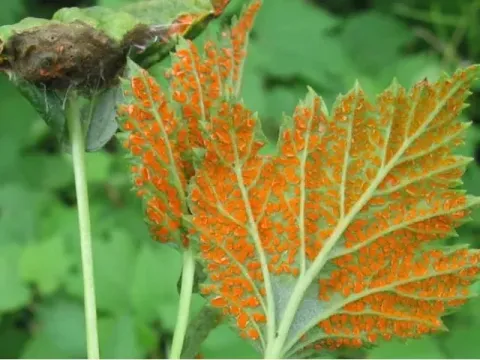
Early symptoms appear at the start of the growing season as small yellowish-orange spots on the upper leaf surface. Over time, prominent pustules filled with rust-colored spore powder develop on the undersides of the leaves.
As the infection progresses, these spots may merge, covering most of the leaf area. This leads to premature chlorosis, leaf curling, and eventual shedding, which significantly stresses the plant.
On current-season canes, symptoms appear as elongated, pale lesions that may crack open to expose spore masses. These structural weaknesses make the canes brittle and susceptible to breakage.
In severe cases, massive defoliation occurs by mid-summer, preventing the plant from storing enough energy for winter dormancy. This leads to poor cane maturation and reduced cold tolerance.
- Yellow-orange pustules on leaf undersides.
- Premature leaf drop and yellowing.
- Cracking of stem bark.
- General stunting of the plant.
High relative humidity is the primary catalyst for the development of raspberry rust. Prolonged rainfall, heavy dews, and persistent fog create the perfect microclimate for fungal proliferation.
The optimal temperature range for the pathogen's growth is between 18°C and 22°C. Under these conditions, the incubation period is significantly shortened, potentially leading to widespread infection.
Dense, overgrown plantings with poor air circulation are highly susceptible. Lack of thinning allows moisture to remain on foliage for extended periods, facilitating spore germination.
Waterlogged soils and inadequate drainage weaken the plant's root system, reducing its natural resistance to fungal pathogens. Healthy plants are better equipped to fight off initial infections.
Spores are dispersed by wind, splashing water, and human activity. Accumulated leaf litter under the bushes serves as the primary reservoir for the fungus to restart its cycle every season.
The economic impact of the disease is severe due to significant yield loss. Berries from infected plants are often small, deformed, and have poor flavor, making them unfit for market.
Weakened canes struggle to survive the winter, often resulting in cold injury or total cane dieback. This reduces the number of healthy fruiting canes available for the following year.
Chronic infection drains the plant of vital resources, leading to long-term decline and poor vigor. Eventually, the patch becomes unproductive and requires removal and replanting.
Management costs increase due to the need for chemical intervention and increased labor for sanitation. Product quality is compromised, and fruits are more prone to rapid decay during storage.
If left unmanaged, Hamaspora longissima can devastate an entire raspberry patch within a few years, turning a productive area into a source of fungal spores.
The foundation of management is rigorous sanitation, including the removal and destruction of infected canes and leaf litter after harvest. Keeping the area clean breaks the infection cycle.
Selecting disease-resistant cultivars is the most effective long-term strategy for preventing rust. Investing in certified, disease-free nursery stock is critical for any new plantation.
Fungicides containing copper or specific systemic triazoles are effective when applied at the first signs of symptoms. Proper timing and adherence to label instructions are essential for success.
Implementing drip irrigation avoids wetting the foliage, which is a major factor in spore transmission. Proper spacing and regular thinning improve airflow and help foliage dry out quickly.
Preventative sprays applied in early spring help keep the infection pressure low. By maintaining healthy conditions and regular monitoring, growers can protect their crop from the damaging effects of raspberry rust.