
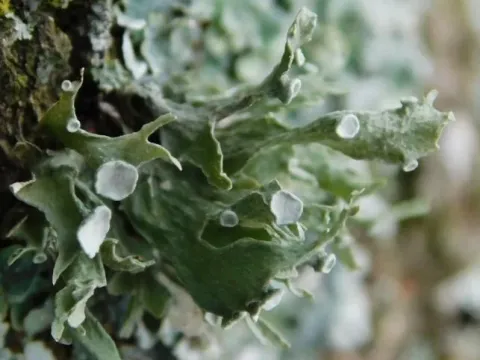
Ramalina
Ramalina
Ramalina is a genus of fruticose lichens commonly found growing on the bark of mature trees, appearing as bushy or hanging structures.
What the section contains
Ramalina
These lichens often exhibit a pale green, greyish, or yellowish color, with flattened or thread-like lobes that extend from the point of attachment.
They are typically found on the trunks and branches of older fruit trees where the bark provides a stable, rough surface for their anchoring structures.
In wet conditions, the thallus of the lichen becomes soft and vibrant, while in dry weather, it turns brittle, lightens in color, and may detach during strong winds.
The appearance of patches or "beards" of lichen on tree limbs is a clear sign that the tree has a microenvironment suitable for epiphyte growth.
Ramalina is not a pathogen; it is a symbiotic organism consisting of a fungus and an alga, functioning as an epiphyte rather than a parasite.
It does not derive nutrients from the tree's sap or inner tissues; instead, it obtains its water and minerals from the air, rain, and accumulated dust.
The lichen relies on the bark exclusively for physical support, utilizing the tree's architecture to access sunlight and moisture in the atmosphere.
Dispersal occurs via the fragmentation of the thallus or through the release of reproductive structures that are carried by the wind to new surfaces.
Because it thrives only in clean air environments, the presence of Ramalina often indicates that the orchard's surrounding air quality is relatively high.
High humidity and poor air circulation within the tree canopy are the primary factors that facilitate the rapid colonization of Ramalina.
Trees that have not been pruned for several years provide dense shade and stagnant air, creating perfect conditions for these lichens to flourish.
Old trees with thick, rough, or fissured bark are preferred hosts as they trap debris and moisture, providing an ideal substrate for the lichen to establish.
Prolonged foggy or rainy seasons provide the necessary moisture for the metabolic activity and growth expansion of the lichen colony.
Neglecting basic orchard hygiene, such as bark cleaning and thinning the canopy, allows the lichen to establish long-term dominance on the tree surface.
While not directly feeding on the tree, excessive cover of Ramalina can obstruct the natural gas exchange of the bark, potentially stressing the tree.
A dense layer of lichen creates a moist habitat that often serves as a refuge for pests like scale insects, mites, and various fungal pathogens.
The constant moisture held against the bark by the lichen can lead to softening of the outer protective layers, increasing the risk of rot development.
Heavy growth masks the condition of the tree bark, making it difficult for the grower to perform effective visual inspections for cracks or early signs of disease.
Overall, an extensive lichen cover can lead to tree decline, manifesting in reduced vigor and slowed growth due to the cumulative environmental stress.
Mechanical removal using soft wire brushes or wooden scrapers during the dormant season is the most effective method for controlling lichen populations.
Whitewashing tree trunks with a lime-based solution during the autumn helps to create an alkaline environment that discourages new lichen attachment.
Pruning the canopy to improve air circulation and light penetration is essential to discourage the damp microclimate that Ramalina requires.
Applying iron sulfate solutions to the trunk and branches effectively kills the lichen and helps to disinfect the bark surface from other potential pathogens.
Maintaining tree vigor through proper fertilization and irrigation ensures that the bark remains healthy and resistant to persistent colonization by epiphytes.