
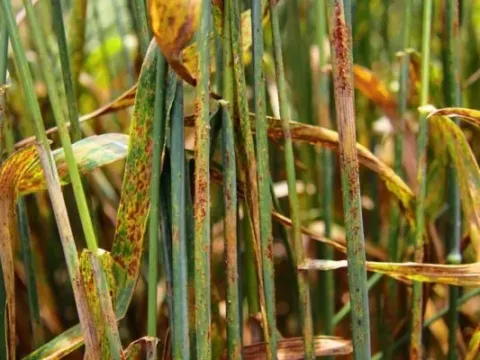
Brown rust of bluestem
Puccinia versicolor
The causative agent of this disease is the rust fungus Puccinia versicolor. It is an obligate parasite that requires living host tissue to complete its life cycle and obtain nutrients.
What the section contains
Brown rust of bluestem
The life cycle involves several spore stages, typical for many rust fungi. Urediniospores are the primary inoculum, responsible for the rapid spread of the disease within a field throughout the growing season.
Teliospores are produced later in the season as survival structures. These spores are capable of overwintering on plant debris or living plant crowns, ensuring the disease returns the following spring.
Dissemination occurs primarily via wind currents, which can carry spores over long distances. High humidity and surface moisture are essential for the spores to germinate and infect the leaf tissue of susceptible grasses.
The fungus is highly specialized, primarily affecting species within the Andropogon genus. Genetic variability within the pathogen population can sometimes lead to the emergence of new races capable of overcoming host resistance.
The disease is characterized by the appearance of numerous small pustules (uredinia) on the leaf surfaces. These pustules are typically brown or reddish-brown in color, reflecting the masses of spores erupting through the epidermis.
Infection often starts on lower leaves and progresses upward. As the disease advances, leaves become chlorotic and eventually dry out, giving the plant a scorched, rusty appearance.
When the infection is severe, the pustules can coalesce, covering large portions of the leaf blade. This significantly reduces the functional photosynthetic area, causing physiological stress to the grass.
Towards the end of the season, the fungus produces telia, which appear as darker, often black, spots on the affected tissue. This transition marks the end of the active infection phase of the life cycle.
Field diagnosis is usually straightforward based on the presence of the characteristic rusty spore masses. However, microscopic examination is required to confirm the specific morphological traits of Puccinia versicolor.
The development of brown rust is heavily influenced by environmental conditions, with moderate temperatures and high humidity being the primary drivers. The ideal temperature range for spore germination is between 15°C and 22°C.
Dew formation and frequent rainfall provide the necessary moisture for the spores to colonize host tissues. Even short periods of high relative humidity are sufficient for successful infection if temperatures are optimal.
Dense stands of grass create a humid microclimate that favors pathogen survival and spread. Poor air circulation within the canopy allows moisture to persist longer on the leaves, facilitating fungal infection.
Plants in the active vegetative stage are typically most susceptible to the disease. The high physiological activity of these plants makes them ideal targets for the fungus to establish its haustoria.
Prolonged dry weather and intense sunlight are detrimental to the spores, often slowing down the progression of the disease and reducing the overall severity of the outbreak.
The primary impact of brown rust is the reduction of forage quality and total biomass yield. By damaging leaf tissue, the disease interferes with photosynthesis, leading to reduced sugar and protein content.
Forage value is significantly degraded, making the grass less palatable to livestock. This can lead to decreased weight gain or reduced milk production in animals grazing on infected pastures.
In addition to biomass losses, severe infections can weaken the plant root system, reducing overall vigor. This makes the stands more susceptible to winterkill and other environmental stresses.
Seed production is also severely affected by the disease. Infected seed heads often fail to fill properly, resulting in lower yields and poor seed quality for future planting.
Repeated annual infections can lead to a long-term decline in stand productivity. If left unmanaged, the pathogen can persist in the field, making it difficult to maintain healthy and productive grass populations.
Selecting and planting resistant or tolerant varieties is the most effective long-term management strategy for brown rust. Breeding programs focus on identifying genetic resistance to the prevailing races of the fungus.
Good management practices, such as timely mowing or controlled grazing, help reduce the amount of inoculum present in the field. Removing older infected tissue prevents the disease from building up.
Ensuring proper stand density and adequate fertilization can help plants maintain vigor and resist infection. Over-fertilization with nitrogen should be avoided as it can sometimes make plants more susceptible.
Fungicides can be used in high-value seed production fields to control the disease. However, their use is rarely practical or economical for large-scale forage pastures due to cost and safety considerations.
Monitoring fields for early signs of infection allows for prompt intervention. Integrating multiple control measures, such as sanitation and cultural practices, is essential for minimizing the impact of Puccinia versicolor.