
Brown snow blight
Herpotrichia
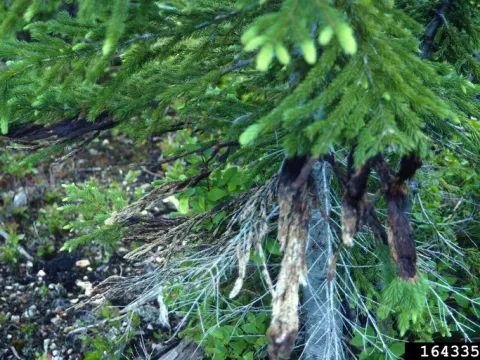
The first and most prominent symptom of Brown snow blight is the appearance of dense, dark-brown or black mycelium that tightly wraps around the needles and small twigs of the affected plant. This is usually visible immediately after the snow melts in the spring.
What the section contains
Brown snow blight
Infected needles lose their natural green color, turning brown, and eventually becoming grey or dirty white as the tissue dies. These needles often become brittle and tend to clump together due to the thick fungal network surrounding them.
Numerous small, black, pinhead-like fruiting bodies of the fungus can be found on the surface of dead needles and twigs. These structures are the indicators of the pathogen's development and are crucial for the spread of the disease to neighboring plants.
The infection typically initiates on the lower branches that were buried under the snow for the longest period during the winter. From there, the mycelium can expand upward through the crown if environmental conditions remain favorable.
A distinctive feature is that the damaged needles remain attached to the branches for a long time, giving the tree a ragged, unhealthy appearance as the rest of the forest or garden starts to grow in the spring.
The causal agents of Brown snow blight are ascomycete fungi belonging to the genus Herpotrichia. The most common species associated with this disease in coniferous forests include Herpotrichia juniperi and Herpotrichia nigra.
This condition is classified as a fungal disease, specifically a type of snow mold. The pathogen is uniquely adapted to survive and thrive in the moist, cool microclimate created beneath a persistent snow cover during the winter months.
The fungus overwinters as active mycelium and fruiting bodies on the infected host tissues. As soon as the snow begins to melt and temperatures rise slightly above freezing, the pathogen resumes its growth, colonizing more of the plant.
The lifecycle involves the production of spores that are disseminated by wind, rain, or insects during the growing season. This ensures the survival of the pathogen and allows it to spread to new hosts in favorable conditions.
The biology of these fungi is characterized by high cold tolerance, allowing them to remain viable even in high-altitude environments or northern latitudes where snow cover is present for most of the year.
The primary prerequisite for the mass development of Brown snow blight is the presence of a prolonged and deep snow cover. This insulating layer maintains a stable temperature around the freezing point, which is optimal for the growth of the fungus.
High relative humidity and soil moisture during the late autumn and winter seasons significantly promote the expansion of the fungal mycelium. Dense plantings with poor air circulation are particularly susceptible to severe outbreaks.
The disease is most frequently observed in sheltered areas, low-lying lands, or on northern slopes where snow remains for longer periods. These locations create the high-humidity microclimate required for the pathogen to thrive.
Conifers that are already weakened by lack of sunlight, improper planting density, or nutrient deficiencies exhibit lower resistance. These stressed individuals often serve as the starting point for infection in a forest or nursery.
Agrotechnical factors, such as poor drainage or excessive nitrogen fertilization, can create an imbalance in the plant's health, making the needles and branches more vulnerable to the colonization by Herpotrichia species.
Brown snow blight poses a significant threat to young coniferous cultures in nurseries and plantations. The loss of needles leads to a sharp decrease in photosynthetic capacity, which stunts the growth of the tree significantly.
Repeated or severe infection weakens the overall health of the tree, making it highly susceptible to secondary attacks by pests like bark beetles or wood borers. In young trees, this often leads to mortality if left untreated.
For ornamental conifers, this disease results in a complete loss of aesthetic value and marketability. The recovery of a damaged crown can take several years, during which the plant remains unattractive.
In forestry, the disease can cause gaps in the stand structure and disrupt the development of young growth. This necessitates expensive sanitation logging and replanting, which impacts the economic stability of the forest management plan.
The ability of the pathogen to spread quickly across large areas means that without regular monitoring, an infection can escalate into an epidemic, impacting large sections of a forest or nursery within a single season.
Prevention is the most effective management strategy for Brown snow blight. This includes selecting well-drained planting sites and ensuring adequate spacing between trees to facilitate air movement and minimize humidity.
Sanitation practices are critical; removing and disposing of heavily infected branches or trees reduces the amount of inoculum available to spread the disease in the following season. This should be done before the onset of the next winter.
The application of copper-based fungicides in the early spring, immediately after the snow melts but before new buds break, can effectively suppress the growth of the fungus and protect healthy tissues.
Selecting disease-resistant conifer species and maintaining high tree vigor through proper fertilization (focusing on potassium and phosphorus) significantly improves the ability of plants to withstand the fungal pressure.
- Frequent monitoring of conifers for signs of fungal matting right after snowmelt.
- Pruning lower branches that touch the soil to prevent initial infection.
- Avoiding excessive nitrogen fertilizers in late summer which can delay dormancy.
- Implementing biocontrol measures to inhibit mycelial growth in the environment.