
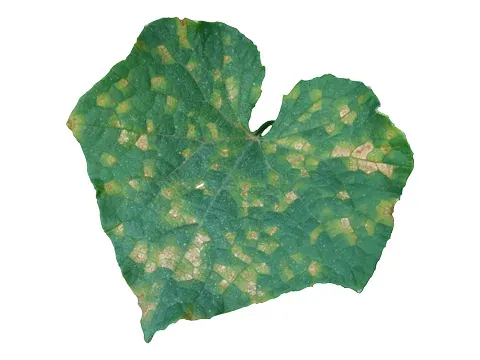
Downy mildew
Pseudoperonospora
Early symptoms of downy mildew appear on the upper leaf surface as chlorotic, yellow or light green spots that are often bounded by the leaf veins, giving them an angular shape.
What the section contains
Downy mildew
In high humidity, a characteristic fuzzy growth of spores, ranging from grey to purple in color, develops on the undersides of the infected leaves.
As the infection progresses, these spots enlarge and coalesce, eventually turning necrotic (brown), which leads to premature leaf drying and senescence.
The infection typically starts on the lower leaves of the plant and moves upwards, especially in densely planted fields or under greenhouse conditions.
Severe infestations result in distorted leaf growth, stunted development, and a sharp decline in photosynthetic efficiency, which significantly hampers plant vigor.
Downy mildew is caused by oomycetes belonging to the family Peronosporaceae, with Pseudoperonospora being a major genus affecting many horticultural crops.
These organisms are obligate parasites that rely on a complex life cycle, producing motile zoospores that require free water to infect host tissues.
The pathogen can persist in the soil as oospores or survive in crop debris, providing a reliable source of primary inoculum for subsequent planting seasons.
Zoosporangia are easily dispersed by wind currents or water splashes during rain events, facilitating rapid spread across commercial fields.
The biological nature of the pathogen allows it to reproduce exponentially under optimal conditions, making it one of the most challenging diseases for growers.
Optimal development of downy mildew occurs when relative humidity is consistently above 80–90% combined with moderate temperatures between 15°C and 22°C.
The presence of free moisture, such as dew, fog, or overhead irrigation, on the leaf surface is a critical requirement for zoospore germination and infection.
Poor aeration in greenhouses or overly dense planting patterns in the open field creates a microclimate that promotes rapid mycelial growth.
Fluctuating temperatures between day and night encourage condensation, which provides the water film necessary for the pathogen to thrive.
Lack of proper field sanitation and failure to rotate crops can lead to a buildup of inoculum in the soil, increasing the risk of early-season outbreaks.
The primary economic damage caused by downy mildew is the rapid loss of leaf area, which halts fruit development and reduces total yield quantity.
Defoliation exposes fruits to direct sunlight, causing sunscald damage and reducing the marketability of the harvested crops.
The plant loses its resilience and health, making it more susceptible to secondary infections and reducing the overall quality of the agricultural product.
Sugar content and flavor profile of fruits may decline, and post-harvest storage life is often significantly reduced due to weakened plant metabolism.
In highly susceptible crops like cucumbers, downy mildew can result in total crop failure if management and protective measures are not implemented promptly.
Effective management begins with strict crop rotation, ensuring that susceptible host plants are not grown on the same land for at least 3–4 years.
Selecting and planting resistant or tolerant varieties is the most sustainable strategy to minimize damage and reduce the need for chemical interventions.
Implementing proper agronomic practices, such as maintaining optimal plant spacing and using drip irrigation, helps minimize humidity levels around the foliage.
Chemical control involving systemic and contact fungicides is effective, provided that labels are followed and modes of action are rotated to prevent resistance.
- Sanitation by removing and burning infected plant debris.
- Using greenhouse ventilation to keep humidity levels low.
- Regular disinfection of greenhouse structures and equipment.
- Scouting regularly to detect early signs of infection.