
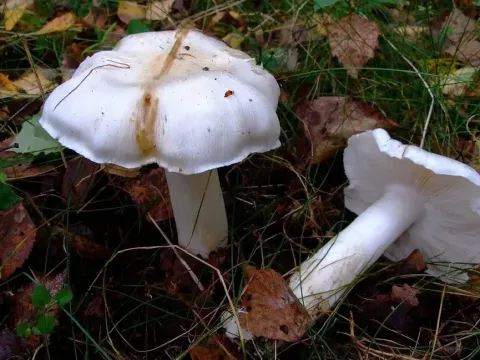
Dove mushroom
Tricholoma columbetta
It is important to clarify that the Dove mushroom (Tricholoma columbetta) is not a plant disease or a crop pathogen. It is an edible fungus belonging to the Tricholomataceae family that plays a beneficial role in forest ecosystems.
What the section contains
Dove mushroom
This mushroom forms a mycorrhizal relationship with the root systems of various deciduous trees. By exchanging nutrients and water for carbohydrates, it helps maintain the health and vigor of forest trees.
Unlike pathogenic fungi, Tricholoma columbetta does not cause tissue degradation, wilting, or necrosis in agricultural plants. It exists in harmony with the host trees rather than parasitizing them.
The mycelium of this fungus contributes to the biological activity of forest soil, breaking down organic matter and improving overall soil health. Its presence is often a sign of a stable and ecologically rich habitat.
Since this fungus does not affect crops, it requires no disease control or agricultural protective measures. It should be recognized as a valuable component of the biodiversity of woodlands.
The fruit body of the dove mushroom is typically pure white, sometimes with a subtle bluish or yellowish tint in the center of the cap. The cap surface is smooth, though it may develop fine scales in dry weather.
The gills of the mushroom are crowded, white, and either adnate or slightly notched near the stem. The stem is solid, fleshy, and often displays a fibrous texture, which is a distinctive morphological trait.
The flesh of the mushroom is white, firm, and does not change color when cut. It is known for its pleasant, mild, flour-like odor and taste, which makes it a desirable culinary find.
A key identification feature is the absence of a ring on the stem and the lack of a volva. The cap diameter typically ranges from 5 to 12 centimeters, depending on the maturity of the mushroom.
- Cap: White, convex, becoming flat with age.
- Stem: White, cylindrical, up to 10 cm long.
- Gills: White, crowded, free or slightly adnate.
- Spore print: White.
The dove mushroom primarily inhabits deciduous and mixed forests, forming close associations with birch, beech, and oak trees. It favors moderately moist, organic-rich soils typical of mature woodland floors.
The peak fruiting period occurs from late summer through late autumn. Favorable conditions for the development of fruit bodies include high ambient humidity and moderate forest floor temperatures.
This species thrives in well-drained areas, generally avoiding stagnant water or excessively compacted soil. It is frequently observed along forest paths or in clearings where the forest floor is intact.
The mycelium is long-lived and develops slowly in the forest soil. This long-term association means that mushrooms often reappear in the same locations year after year, provided the environmental conditions remain consistent.
The ideal temperature range for the development of the fruit bodies is between 12 and 18 degrees Celsius. Excessive heat or drought conditions tend to inhibit the growth of this specific fungus.