
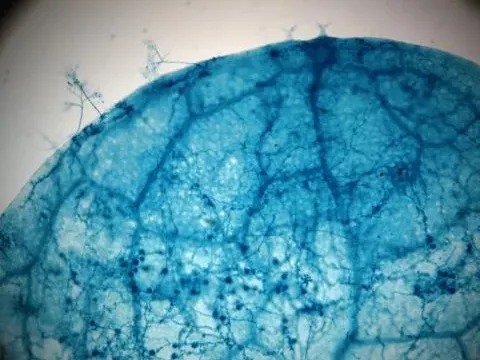
Downy mildew of Arabidopsis
Hyaloperonospora arabidopsidis
The early symptoms of the disease appear as chlorotic spots on the leaf surface. These areas gradually become yellow, indicating the breakdown of chlorophyll due to the pathogen's activity.
What the section contains
Downy mildew of Arabidopsis
Under high humidity conditions, a characteristic white to grayish fungal-like growth appears on the underside of the leaves. This is the sporulation of the pathogen, which is a key diagnostic feature.
As the infection advances, necrotic lesions develop between the leaf veins. These dead tissues eventually merge, causing significant leaf damage and loss of plant vigor.
Severe infection leads to leaf deformation, curling, and early senescence. Young plants show significant stunting, which limits their ability to compete and survive.
In the reproductive phase, the inflorescence stalks can be stunted and curled. This prevents the normal development of flowers and the production of viable seeds.
The causal agent is Hyaloperonospora arabidopsidis, an obligate biotrophic oomycete. It is a highly specialized pathogen that specifically targets members of the Brassicaceae family.
The lifecycle consists of both asexual production of zoospores and sexual production of oospores. Oospores are survival structures that allow the pathogen to persist under adverse conditions.
The pathogen grows intercellularly and obtains nutrients from the host cells through specialized structures called haustoria. These structures penetrate the host cell wall without rupturing the membrane.
Hyaloperonospora arabidopsidis is a premier model organism in molecular plant-microbe interaction studies. It is extensively used to understand how plants recognize and defend against pathogens.
Due to its high genetic diversity, the pathogen can overcome host immunity, posing a continuous challenge for researchers trying to maintain disease-free plant stocks.
High humidity levels (typically over 80-90%) are essential for the germination of zoosporangia and the initiation of the infection process. This makes damp conditions the primary driver of outbreaks.
The pathogen thrives at cool to moderate temperatures, typically between +15°C and +20°C. Within this range, the pathogen's lifecycle is highly accelerated.
Poor ventilation and high planting density create a microclimate conducive to infection. The presence of free water on leaf surfaces is necessary for the movement of zoospores.
Spores are primarily dispersed by air currents. In controlled environments, human activity and tools act as secondary vectors for spreading the oomycete.
Stressed plants with poor air circulation are particularly prone to infection, as the pathogen exploits the lack of environmental control to colonize the host tissues.
The disease severely impacts photosynthesis by destroying chloroplasts in infected leaves. This leads to a substantial loss of metabolic energy and overall plant health.
In research settings, an outbreak can destroy valuable experimental lines of Arabidopsis, causing the loss of years of genetic data and resources.
Infection affects seed production and quality. The seeds obtained from diseased plants may have reduced viability, which is detrimental for breeding and genetic studies.
The necrotized tissues provide an entry point for secondary bacterial and fungal infections. This often leads to a faster collapse of the plant than the oomycete alone.
The economic and academic harm is primarily characterized by the disruption of research projects and the requirement for intensive labor to re-establish clean stocks.
Strict phytosanitary practices are the first line of defense. Regular disinfection of tools, pots, and laboratory surfaces is vital to prevent pathogen spread.
Managing the greenhouse environment is crucial. Reducing relative humidity and ensuring good air circulation can effectively prevent the onset of the disease.
Breeding for resistance is the most effective long-term strategy. Researchers identify and utilize specific resistance genes (R-genes) to protect Arabidopsis lines.
While fungicides can be used, their application in research settings is often limited to avoid experimental interference. Biological control agents are sometimes preferred.
Proactive removal and destruction of infected plant material are mandatory to isolate outbreaks and protect the remaining population from further spread.