
Downy mildew of brassicas
Hyaloperonospora brassicae
The pathogen responsible for this disease is Hyaloperonospora brassicae, an obligate oomycete parasite. It is highly host-specific, primarily infecting plants within the Brassicaceae family.
What the section contains
Downy mildew of brassicas
The life cycle of the pathogen involves the production of sporangia, which are disseminated via wind or water droplets. Once the pathogen reaches a host leaf, it produces mycelium that penetrates the plant tissue to extract nutrients via specialized structures called haustoria.
Overwintering occurs primarily through oospores found in soil debris or on infected seeds. These oospores are highly resilient and can remain viable in the soil for several years, posing a long-term risk to crop rotation cycles.
Primary infection frequently originates from contaminated transplants or volunteer brassica weeds. In protected environments like greenhouses, the pathogen can survive indefinitely if host plants are consistently available.
The biological activity of this oomycete is heavily dependent on moisture. For the sporangia to germinate and successfully infect host tissues, consistent leaf wetness is required, making environmental management a key aspect of disease control.
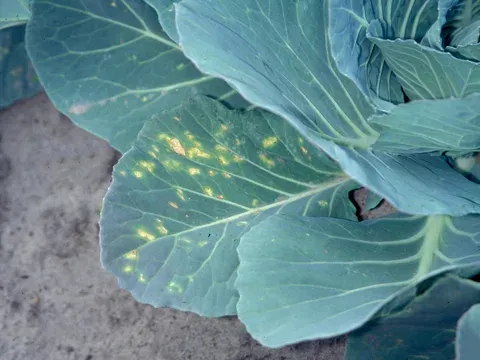
The initial symptoms are characterized by irregular, chlorotic, or yellowing spots on the upper side of the leaves. As the disease advances, these spots may turn brown or necrotic, often restricted by leaf veins.
On the underside of the leaves, a distinct grayish-white fuzzy growth appears. This is the conidial sporulation of the pathogen, which becomes particularly prolific under high-humidity conditions.
In seedlings, the disease causes curling, distortion, and yellowing of the cotyledons, often leading to stunted growth or total plant failure if the infection is severe enough during early development.
In mature cabbage heads, the pathogen can penetrate deep into the tissue. During post-harvest storage, this manifestation appears as dark, necrotic patches that often invite secondary pathogens, leading to rot.
- Yellow leaf spotting
- Grayish-white fuzz on leaf underside
- Leaf distortion and curling
- Premature leaf necrosis
- Dark spots on harvested heads
Downy mildew thrives in cool, humid conditions. Temperatures ranging from 10°C to 18°C are considered optimal for the rapid germination of spores and the progression of the disease.
Diurnal temperature fluctuations that promote heavy dew formation are conducive to disease outbreaks. High relative humidity (exceeding 80-90%) is a critical requirement for sustained pathogen reproduction.
Densely planted crops and poor ventilation in greenhouses create microclimates that trap moisture around the foliage, significantly increasing the probability of a localized epidemic.
Irrigation methods, particularly overhead sprinkling during the evening, are major contributing factors as they ensure the leaf surface remains wet for extended periods, facilitating infection.
The presence of wild cruciferous weeds, such as shepherd's purse or field mustard, acts as a continuous reservoir for the pathogen, allowing it to survive between main crop planting cycles.
The primary damage caused by this disease is the loss of photosynthetic leaf area, which significantly impacts the plant's metabolic capacity and leads to reduced overall yields.
Seedling infestations can cause substantial economic losses by killing off young plants, which requires costly replanting efforts and delays the production schedule for the season.
Market quality is heavily compromised by the disease. Infected heads exhibit poor storage longevity, as the damaged tissues are highly susceptible to secondary bacterial and fungal decay.
Economic impacts include not only the direct loss of yield but also the increased investment in fungicides, labor for application, and the potential devaluation of the harvested product.
Widespread outbreaks can be detrimental to seed production, as the pathogen can contaminate seeds, thereby facilitating its transmission to new geographic regions or farms.
Implementing a strict crop rotation cycle of at least 3-4 years without planting brassicas is the most effective cultural practice for reducing soil-borne inoculum levels.
Ensuring the use of certified, disease-free seed and applying seed treatments can significantly lower the risk of early-season infections in the field or nursery.
Cultural management such as optimizing plant spacing to improve airflow, effective weed control, and drip irrigation instead of overhead watering can reduce humidity levels on leaf surfaces.
Chemical intervention remains necessary in high-pressure environments. The strategic application of systemic or contact fungicides, as permitted by local regulations, can protect crops during high-risk conditions.
Post-harvest sanitation is essential. Crop residues should be plowed deep into the soil or removed to ensure that oospores cannot survive and serve as a primary source of infection for the next season.