
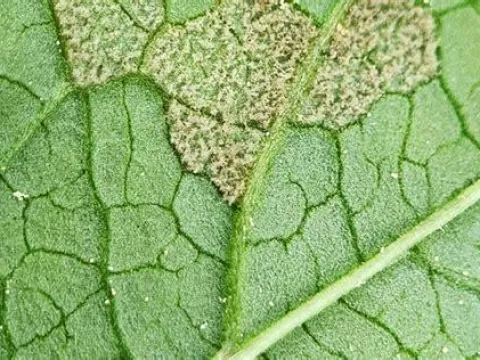
Downy mildew of buckwheat
Peronospora leptoclada
The causative agent of the disease is the oomycete Peronospora leptoclada, an obligate parasite that specifically affects buckwheat plants. It is a fungus-like organism that develops within plant tissues.
What the section contains
Downy mildew of buckwheat
The pathogen reproduces via sporangia, which are dispersed primarily by wind and splashing water. These structures facilitate the rapid spread of the disease within the buckwheat field.
It overwinters in the form of oospores, which remain dormant in soil or on crop debris until the following growing season. This ensures the pathogen's persistence in the agricultural environment.
Infection begins when spores land on susceptible leaves, germinating and penetrating the plant's epidermis. Once inside, the hyphae spread through the intercellular spaces.
The parasite relies on the living host to complete its lifecycle, eventually disrupting the plant's nutritional balance and photosynthesis capacity significantly.
Initial symptoms are characterized by chlorotic, yellowish spots appearing on the upper surface of the leaves. These spots can vary in size and shape depending on the infection stage.
The most diagnostic feature is the appearance of a greyish or violet fungal growth on the underside of the leaves, directly beneath the chlorotic spots.
As the disease progresses, these spots tend to coalesce, leading to necrosis. Affected tissues eventually turn brown, dry out, and may fall away, causing a shothole appearance.
In severe cases, the infection may affect the stems and floral parts of the buckwheat, resulting in stunted development and deformation of the entire plant.
Fields affected by downy mildew often show visible patches of stunted and discolored plants that stand out against healthy sections of the crop.
Downy mildew development is heavily dependent on high humidity, particularly when relative humidity levels remain above 85% for extended periods.
Cool to moderate temperatures, typically between 15°C and 20°C, provide an optimal climate for spore germination and rapid colonization of the plant tissues.
Rainy weather, fog, and the presence of leaf moisture (dew) are the primary drivers for the spread of Peronospora leptoclada across agricultural landscapes.
Dense plant stands with poor air circulation create a microclimate that traps moisture, making these areas highly susceptible to rapid outbreaks.
Excessive application of nitrogen fertilizers can lead to lush, tender growth that is more easily penetrated and colonized by the pathogen's hyphae.
The disease significantly reduces the yield of buckwheat by curtailing the effective leaf area available for photosynthesis and carbon assimilation.
Severe infections lead to the premature senescence of the crop, resulting in smaller, lighter grains and reduced seed quality for subsequent harvests.
Total yield losses in susceptible varieties can be significant, especially during seasons characterized by prolonged wet and humid weather conditions.
Contaminated seeds can act as a primary source of inoculum, potentially introducing the pathogen to previously clean fields in the next growing season.
Plants weakened by the infection are prone to secondary pathogens and have reduced overall vigor, complicating the management of the entire crop rotation system.
- Crop rotation is essential, with a minimum 3 to 4-year interval between buckwheat plantings.
- Use certified and healthy seed lots to prevent the initial introduction of the pathogen.
- Implement spatial isolation between the current year's buckwheat crop and previous fields.
- Deep tillage and burial of crop residues to accelerate their decomposition and eliminate overwintering structures.
- Apply preventative fungicide sprays during critical growth stages when weather conditions favor disease spread.