
Description
Symptoms
The most distinctive symptom of infection is the development of "witch's brooms," which are dense, abnormal clusters of branches caused by the parasite's physiological influence.
Infected areas of the stem and branches often exhibit severe swelling and hypertrophy, as the parasite alters the normal growth patterns of the host tree's tissues.
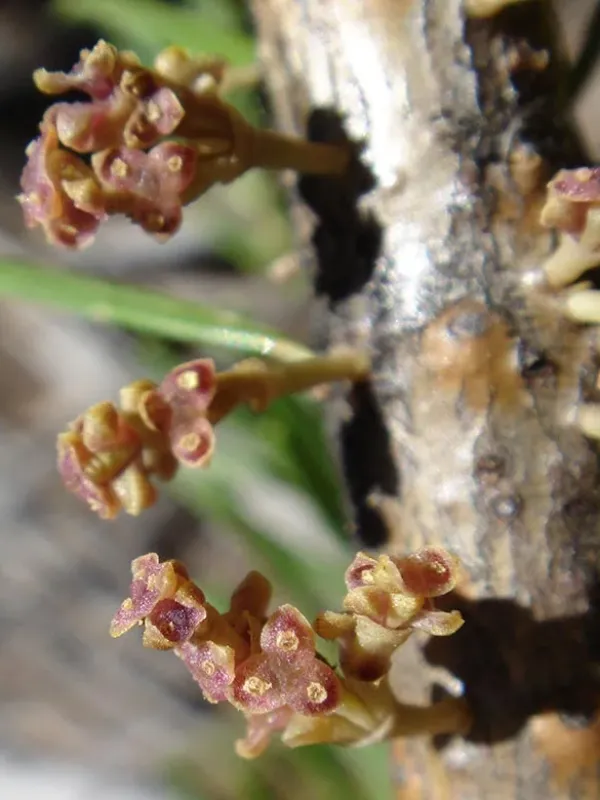
During the flowering season, the small, olive-brown stems of the dwarf mistletoe become visible, although they are often obscured by the dense foliage of the host.
Affected branches suffer from chlorosis and premature needle drop, which typically begins in the inner crown and progresses outward as the parasite drains resources.
As the infection advances, the tree’s overall crown structure becomes sparse and deformed, with top-killing often occurring in the final stages of the parasitic decline.
Pathogen
The causative agent is Arceuthobium douglasii, an obligate parasitic plant belonging to the Santalaceae family that specifically targets species of Pseudotsuga.
Unlike autotrophic plants, this species lacks functional roots and instead utilizes internal root-like structures called haustoria to penetrate the vascular system of the host.
The lifecycle is complex and slow; seeds are forcefully ejected and adhere to host tissues with a sticky substance, initiating a process that can take years to become symptomatic.
The parasite acts as a metabolic sink, redirecting water, minerals, and carbohydrates from the host tree to support its own growth and reproductive processes.
Because it is a specialist, it has evolved to perfectly time its life cycle with the physiological growth patterns of the Douglas-fir, ensuring maximum efficiency as a parasite.
Conditions for development
Dwarf mistletoe thrives in mature and overmature stands where the high density of interlocking crowns facilitates the spread of seeds from infected to healthy trees.
Cool, humid conditions in forest environments favor the successful germination of seeds on the bark of younger, susceptible twigs and branches of the host tree.
The persistence of the parasite is largely dependent on the presence of "source trees"—older infected individuals that rain seeds onto the surrounding understory for decades.
Sites with poor tree vigor or those stressed by environmental factors are often more susceptible to colonization, as their natural defense mechanisms are likely weakened.
The spatial arrangement of the forest, specifically the proximity of susceptible saplings to infected older trees, is the primary driver of epidemic-scale infestations.
Why it matters
The parasitic activity leads to significant growth reduction in the host, resulting in decreased height and diameter development over the lifespan of the tree.
Timber quality is severely compromised due to the formation of wood abnormalities and the associated fungal decays that often enter through the parasite's infection points.
Heavily infested stands experience increased mortality rates, especially during periods of drought or insect outbreaks, as the trees lack the resources to cope with added stress.
In managed forestry, dwarf mistletoe is considered a major economic pest that necessitates costly interventions and shifts in harvest planning to minimize losses.
Beyond commercial impacts, the parasite alters forest structure and composition, potentially affecting local wildlife habitats and ecosystem dynamics over long periods.
Protection
Management primarily relies on silvicultural practices, including the removal of infected overstory trees to break the cycle of seed dispersal to young growth.
Establishing buffer zones and harvesting infected stands in their entirety are effective strategies to prevent the spread of the parasite into uninfected regeneration areas.
Regular forest health monitoring and the identification of infested patches are essential for early detection and targeted management of the parasitic population.
In ornamental or high-value landscapes, manual pruning of infected branches can be used, provided that the haustorial tissues within the wood are fully excised.
- Clear-cutting of heavily infested stands
- Sanitation thinning of isolated infected trees
- Selection of resistant or non-host species for replanting
- Regular inspections of young Douglas-fir plantations
Pathogens and affected parts
Affects crops · 1
Discussion
No discussions yet — be the first.