
Downy mildew of brassicas
Hyaloperonospora erucae
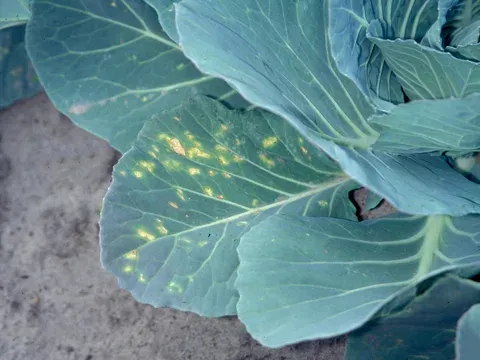
Initial symptoms of downy mildew appear as small, yellowish or light green chlorotic spots on the upper surface of leaves, often bounded by leaf veins.
What the section contains
Downy mildew of brassicas
On the undersides of these infected areas, a fine, fluffy, white-to-grayish growth appears, consisting of the pathogen's spores and sporophores.
As the infection progresses, the spots expand and turn brown or necrotic, leading to the drying out and premature yellowing of the foliage.
On young seedlings, the disease can cause severe cotyledon yellowing and stunting, often resulting in damping-off or total plant collapse.
In mature plants, heavy infestation can cause leaf distortion and significant reduction in photosynthetic capacity, affecting head development.
The causative agent of this disease is the oomycete Hyaloperonospora erucae, which is a highly host-specific, obligate biotroph.
It attacks a wide range of Brassicaceae crops, including broccoli, cauliflower, cabbage, radish, turnip, rapeseed, and mustard.
The pathogen produces oospores that can survive in the soil and crop debris for several years, serving as the primary source of inoculum.
The asexual cycle is driven by the production of sporangia (conidia), which are easily dispersed by wind, rain splashes, and irrigation water.
The fungus penetrates host tissues through stomata and develops an extensive network of hyphae within the intercellular spaces of the plant.
Cool and humid weather conditions are ideal for the development and spread of Hyaloperonospora erucae across agricultural fields.
Temperatures ranging from 10 to 20 degrees Celsius combined with high relative humidity are perfect for rapid sporulation and infection.
Persistent dew, fog, or frequent rainfall provides the necessary moisture on leaf surfaces for spore germination and successful colonization.
In greenhouse environments, poor ventilation leading to high humidity and condensation on leaves creates a major risk for disease outbreaks.
High plant density and limited airflow further exacerbate the spread of the disease within the crop canopy during the growing season.
The economic impact of downy mildew is primarily due to reduced crop quality, marketability, and overall yield potential loss.
Infected seedlings often show poor vigor, which can lead to stand establishment issues and the need for costly replanting in the field.
Necrotic spots on leaves make leafy vegetables like kale or cabbage undesirable for the fresh produce market, causing significant financial losses.
The presence of lesions provides an entry point for secondary pathogens, such as soft rot bacteria, which can destroy the produce during storage.
Significant outbreaks can lead to yield reductions exceeding 40% in sensitive cultivars if control measures are not implemented promptly.
Crop rotation is the most effective cultural practice, as it prevents the buildup of oospores in the soil by avoiding host crops for several years.
Sanitation is critical; all crop residues should be incorporated into the soil or removed to reduce the primary inoculum load for the next cycle.
Using certified, disease-free seed and applying appropriate seed treatments can prevent the introduction of the pathogen into new areas.
Fungicide applications are necessary under high disease pressure, using chemicals with protective and systemic modes of action for better control.
- Monitor fields regularly, especially during cool and damp periods, for early signs of infection.
- Improve air circulation within the canopy by adjusting plant spacing and thinning.
- Control brassica weeds that may serve as alternative hosts for the oomycete.