
Physalacriaceae
Physalacriaceae
The Physalacriaceae family consists of several basidiomycete fungi, most notably the Armillaria genus, which are responsible for severe root and butt rot diseases in a wide range of woody plants.
What the section contains
Physalacriaceae
The primary pathogen mechanism involves the growth of mycelium, which spreads through the soil via rhizomorphs—tough, root-like structures that allow the fungus to navigate and colonize new hosts.
These fungi are considered facultative parasites, meaning they can thrive as saprotrophs on decaying wood while maintaining the ability to infect living, stressed trees.
Biologically, the pathogen exploits wounds, cracks, or dead root tissue to gain access to the host's cambium layer, where it rapidly proliferates.
The resilience of these fungi is enhanced by their ability to survive in organic debris within the soil for many years, waiting for an opportunity to infect nearby trees.
Typical symptoms of infection include premature yellowing of leaves, wilting, and overall decline in tree vigor, often starting from the crown downwards.
White, fan-shaped mycelial mats, known as "mycelial fans," are frequently found under the bark at the base of the trunk or on the main roots.
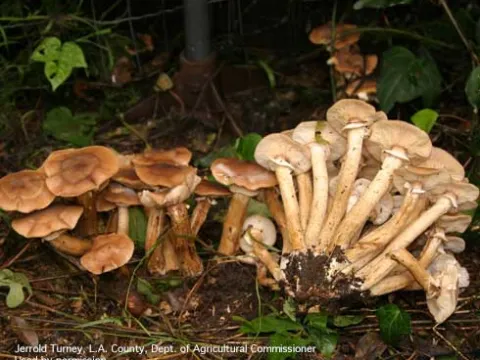
In late summer or autumn, characteristic mushroom clusters (fruiting bodies) may emerge at the base of the infected host or on nearby roots.
Dark, cord-like structures called rhizomorphs can often be observed on the surface of the roots or in the surrounding soil, acting as diagnostic markers.
Internal wood decay is characterized by a white, spongy rot often featuring black "zone lines" that separate different stages of fungal decomposition.
Physalacriaceae development is strongly favored by high soil moisture, poor drainage, and environments where air circulation is restricted.
The pathogen spreads most rapidly in sites where old stumps or infected roots remain in the ground, providing a constant source of inoculum for new plantings.
Stress factors in trees, such as drought, nutrient deficiency, or prior damage from insects, significantly lower their defense mechanisms, making them susceptible to infection.
Optimal temperatures for active fungal growth and rhizomorph spread typically range from 15 to 25 degrees Celsius, matching the temperate climate zones.
The presence of dense root systems allows the fungus to move easily from one host to another via root-to-root contact in orchard or forest settings.
Physalacriaceae fungi pose a significant economic threat to arboriculture and forestry by causing widespread mortality in both fruit and timber trees.
The destruction of the root system and cambium disrupts water and nutrient transport, which inevitably leads to the decline and eventual death of the affected plant.
These pathogens cause substantial loss of commercial productivity, forcing growers to remove entire orchard blocks and leave land fallow for extended periods.
Beyond killing the trees, the wood degradation caused by these fungi renders timber useless for construction or furniture production, adding to the total loss.
Because these pathogens are persistent in the soil, they create "disease centers" that prevent the successful establishment of new, susceptible young trees.
Effective management begins with rigorous sanitation, including the complete removal of infected trees and their entire root systems from the site.
Stump removal is essential, as remaining wood provides a long-term reservoir for the fungus to persist and infect subsequent plantings.
Physical isolation, such as digging deep trenches around infected zones, can help stop the spread of rhizomorphs through the soil to healthy neighboring trees.
Maintaining optimal tree health through proper fertilization, adequate watering, and stress management is the best long-term strategy for preventing initial infection.
When necessary, localized soil treatments with appropriate fungicides or biological control agents can be used to suppress fungal activity in the rhizosphere.