
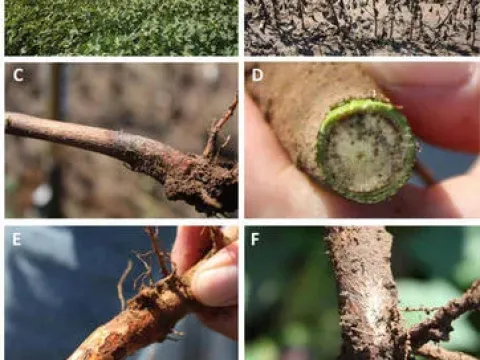
Phymatotrichopsis root rot
Phymatotrichopsis
The causal agent is the soilborne fungus Phymatotrichopsis omnivora, known for its extreme persistence and ability to remain in soil for many years.
What the section contains
Phymatotrichopsis root rot
The fungus produces sclerotia, which serve as resilient resting structures that allow the pathogen to survive in deep soil layers during unfavorable seasons.
It spreads primarily through vegetative growth of mycelial strands that travel from infected roots to healthy neighboring plants in the field.
This pathogen is highly non-specific, capable of attacking a vast array of dicotyledonous plants, which makes it a nightmare for farmers in affected regions.
The life cycle is primarily adapted to high temperatures, making the fungus particularly aggressive in warm, semi-arid environments.
The first external sign of infection is a sudden wilting of the leaves, which often starts in one part of the plant and progresses rapidly during hot periods.
As the disease advances, leaves turn yellow and eventually bronze-colored, drying out completely but remaining attached to the stems.
Root systems of affected plants show distinct discoloration and decay, with the bark becoming soft and easily separable from the woody core.
Under magnification, you can observe light-colored, web-like mycelial strands radiating across the surface of the infected root system.
- Sudden wilting during peak daylight hours.
- Bronze discoloration of foliage.
- Mycelial strands on the roots.
- Root decay and bark shedding.
The disease thrives in warm soil temperatures, specifically ranging between 25°C and 30°C, and is rarely found in cold climates.
Alkaline soils with high calcium content are highly conducive to the growth and successful colonization of the fungus.
Significant moisture fluctuations, such as heavy rain following a dry spell, often trigger accelerated disease development and mycelial spreading.
Poorly aerated soils that retain heat contribute to the spread of the pathogen, as the fungus requires specific oxygen levels for its growth.
Continuous cultivation of susceptible crops without rotation leads to a rapid increase in the pathogen population density in the soil.
This fungus is responsible for the destruction of over 2,000 species, including cotton, alfalfa, fruit trees, and various nut-producing orchards.
The damage often manifests in circular spots in fields that expand annually, causing total crop loss within those affected areas.
It causes significant economic losses because affected fields can become unsuitable for the production of highly profitable but susceptible crops.
For perennial crops, the disease is particularly devastating as it kills mature trees, requiring costly replanting and long recovery periods.
The persistent nature of the fungus means that once a field is infested, the pathogen remains a threat for a very long time, hindering production.
Effective management includes implementing long-term crop rotation cycles using non-host crops such as corn, sorghum, or small grains.
Deep plowing can help break up mycelial strands and disturb the habitat of the fungus, though this is rarely enough to eradicate the disease alone.
Adding organic matter to the soil helps improve soil health and promotes microbial activity that can act as a natural biological control.
Early diagnosis and quarantine of infested patches are essential to prevent the pathogen from being carried to other parts of the field via equipment.
Research into resistant cultivars remains the most promising long-term strategy for managing fields where the pathogen is firmly established.