
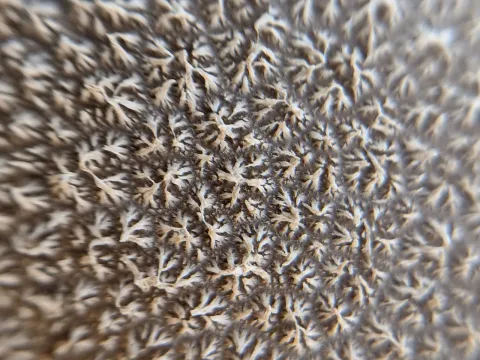
Soft puffball
Lycoperdon molle
The soft puffball (Lycoperdon molle) is a basidiomycete fungus characterized by a spherical or pear-shaped fruiting body that lacks a distinct stem.
What the section contains
Soft puffball
When young, the surface is covered in delicate, soft spines or warts that fall off as the mushroom matures, revealing a smooth, brown surface.
As the puffball reaches maturity, the interior flesh turns into a mass of brown spores, which are released through a small apical pore at the top.
These fungi typically grow in clusters within forest leaf litter, feeding on decaying woody debris and organic matter on the forest floor.
It is crucial to recognize that this species is not a plant pathogen; it is a saprotroph that plays a beneficial role in nutrient cycling.
The biological agent behind this fungus is the mycelium of Lycoperdon molle, which thrives in soil rich in decomposing organic material.
This fungus does not infect living plant tissues, meaning it poses no threat to agricultural crops, garden plants, or tree health.
The fungus functions by decomposing complex organic compounds like lignin and cellulose, which helps in the formation of humus in the soil profile.
Its life cycle is entirely dependent on decaying organic substrates and appropriate environmental moisture levels to produce fruiting bodies.
In the context of plant pathology, this organism is classified as beneficial or neutral, strictly lacking any disease-causing potential for crops.
The soft puffball requires high moisture levels and a stable supply of organic debris to develop effectively, commonly appearing during the rainy season.
It is predominantly found in coniferous and mixed forests, where dense leaf litter provides a perfect, humid microenvironment for mycelial growth.
Temperatures ranging from 15 to 22 degrees Celsius are ideal for the rapid expansion of the fungus and the emergence of its fruiting bodies.
It thrives in acidic, well-mulched soils where the breakdown of organic matter provides a continuous nutrient source for its growth.
Spore dispersal is facilitated by wind and physical impact, such as raindrops hitting the mature puffball, which ejects clouds of spores into the air.
The soft puffball is not a pest or a disease agent in agriculture. It causes no damage to crop health, yield, or product quality whatsoever.
There is no competition for nutrients between this fungus and cultivated plants, as its diet consists entirely of dead organic remnants.
By breaking down woody debris and leaves, this fungus assists in clearing fields of harvest residue, acting as a natural soil cleaner.
Agricultural managers should not be concerned about the presence of this fungus, as it is a natural component of healthy, productive soils.
No negative economic impact or agricultural damage has ever been associated with the lifecycle or proliferation of Lycoperdon molle.
Since the soft puffball is not a pathogen, there is no need for chemical treatment, and applying fungicides would be environmentally counterproductive.
If mushroom clusters appear in unwanted areas, simply removing the fruiting bodies before they release their spores is sufficient to limit local spread.
Proactive management of organic residues and ensuring proper soil drainage can reduce the environmental suitability for these fungi if they are undesirable.
Promoting a balanced soil microbial community is far more effective than trying to eradicate non-pathogenic saprotrophs like the soft puffball.
Ultimately, these organisms are indicators of organic content in the soil and should be allowed to perform their natural ecological function.