
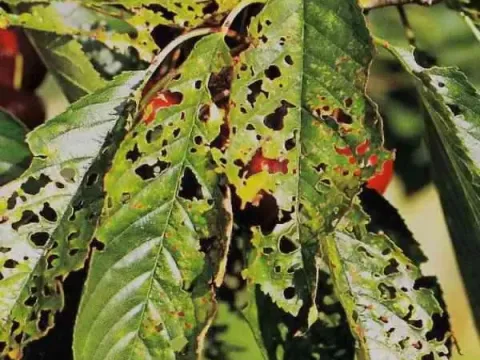
Shot hole disease
Coryneum
The disease is caused by the fungus Wilsonomyces carpophilus, which is a significant pathogen affecting stone fruit trees worldwide.
What the section contains
Shot hole disease
The fungus survives the winter season as mycelium or spores within infected buds, bark cankers, and sometimes on fallen diseased leaves.
During the growing season, conidia are spread across the orchard primarily through water splashes from rain and by wind currents.
This pathogen demonstrates a high capacity to colonize plant tissues, entering the tree through natural openings and fresh wounds.
Its biological activity is persistent throughout the year, with peaks of infection correlating with periods of high moisture and humidity.
Initial symptoms include small, reddish-brown spots on leaves, which gradually develop a distinct dark border or halo.
The necrotic tissue in the center of these spots dries out and drops away, leaving characteristic shotholes, giving the disease its common name.
Young twigs show reddish-purple spots that expand into sunken cankers, often accompanied by significant gummosis, or sticky sap exudation.
Fruit infection manifests as small, raised bumps that can develop into dark, depressed lesions, often causing fruit distortion and scabbing.
Severely infected buds often blacken and die before they have the chance to open, leading to stunted canopy growth and reduced foliage.
The development of the fungus is heavily favored by cool, wet weather conditions, particularly during the early spring and autumn months.
Optimal temperatures for the growth of the pathogen are generally between +15 and +22 degrees Celsius in the presence of moisture.
Orchards with poor air circulation, dense canopies, or neglected maintenance are significantly more susceptible to severe outbreaks.
Extended periods of leaf wetness are essential for the spores to germinate and penetrate the host tissue effectively.
Improper irrigation practices that keep foliage wet for long durations can exacerbate the spread of the fungus within the canopy.
Shot hole disease significantly reduces tree vigor by inducing premature leaf drop, which hinders the tree's ability to produce energy.
Cankers on branches cause long-term damage, potentially obstructing the transport of water and nutrients throughout the tree structure.
The market value of harvested fruit is drastically reduced due to blemishes, pitting, and general deformation caused by fungal lesions.
Continuous infection weakens the tree's immune system, making it more prone to secondary infections and winter frost damage.
If left unmanaged, the cumulative stress and tissue damage can eventually lead to the death of branches or entire trees over several seasons.
The primary control measure involves regular sanitary pruning to remove all infected branches and twigs, which should be destroyed immediately.
Applying copper-based fungicides during the dormant season and at petal fall is critical for reducing the initial spore load.
Treating trunk and branch cankers involves cutting out necrotic wood and applying a protective wound dressing to prevent reinfection.
Balanced fertilization is recommended to avoid excessive succulent growth, as fast-growing tissue is more vulnerable to fungal entry.
- Remove and dispose of all fallen leaves during the dormant season.
- Ensure adequate spacing between trees to improve air flow.
- Sterilize all pruning tools after contact with infected trees.