
Shot hole disease
Pruniphilomyces circumscissus
Description
Symptoms
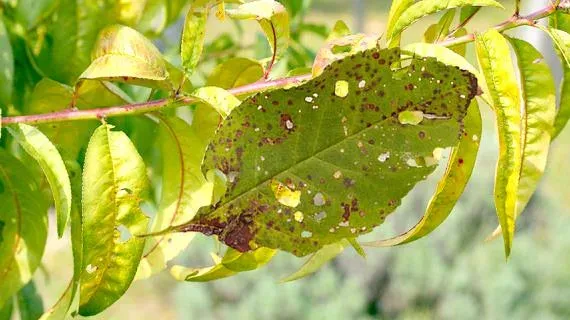
Initial symptoms appear on leaves as small, circular, reddish-brown spots with a darker border. After 1–2 weeks, the affected tissue dies, dries out, and falls away, leaving characteristic perforations, which give the disease its name.
On young shoots, spots appear as red dots that gradually enlarge and turn into cankers. These cankers often exude thick gum, which serves as a sign of the plant's intense reaction to the pathogen's penetration.
Fruits are also susceptible; they develop sunken purple spots. In cases of severe infection, the fruit surface becomes covered with warts, deforms, and the flesh in the affected areas dries up to the pit.
Flowers and buds turn brown and fall off when infected, which significantly reduces potential yield at the blooming stage. Flower drop is often accompanied by infection of the flower stalks.
Heavily infected leaves turn yellow and drop prematurely, which weakens the tree before the dormant period and impairs the development of fruit buds for the following year.
Pathogen
The causal agent of this disease is the fungus Pruniphilomyces circumscissus (formerly known as Clasterosporium carpophilum). The infection overwinters as mycelium in infected shoot tissues, buds, and fallen leaves throughout the dormant season.
In spring, fungal spores are actively dispersed by wind, rain, and insects, infecting young plant organs. The fungus exhibits high adaptability and can develop within a wide temperature range, making it highly resistant to adverse environmental conditions.
The pathogen's life cycle is closely linked to moisture: conidia production occurs during high atmospheric humidity and moderate temperatures. The primary source of infection is diseased buds and cankers on the tree branches.
Fungal mycelium can penetrate deep into plant tissues, causing not only superficial spots but also more severe damage to the vascular system. Constant accumulation of spores within the canopy leads to annual disease outbreaks whenever conditions are favorable.
The biological characteristics of the fungus include the ability to form conidial sporulation throughout the entire growing season, which ensures the renewal of infection with every rainfall event.
Conditions for development
The development of the disease is favored by wet and moderately warm weather. Optimal conditions for spore germination occur during frequent rains, fog, or heavy dew, especially in the spring.
The temperature range favorable for infection varies from +10°C to +25°C. At these temperatures, the incubation period shortens, and new spots can appear just days after the initial infection.
Dense tree canopies, lack of airflow, and poor light conditions create a microclimate with high humidity, which is a critical factor for the rapid spread of fungal spores.
The infection level increases significantly in orchards where regular sanitary pruning and removal of infected branches are not performed. Accumulation of plant debris under the tree canopy contributes to the pathogen's survival.
Stressed or weakened trees, whether due to improper cultivation or nutrient deficiency, become more susceptible to the intrusion of Pruniphilomyces circumscissus mycelium.
Why it matters
The primary damage results from premature leaf drop, which disrupts photosynthesis. This leads to tree exhaustion, poor shoot maturation, and reduced overall winter hardiness.
Infection of fruits makes them unsuitable for sale or processing, as they lose their market quality, deform, and rot. In severe cases, yield losses can reach 50–70%.
Cankers on shoots impede proper sap flow. In areas of severe damage, entire branches may die, leading to gradual drying and even the death of the entire tree if treatment is neglected.
Gummosis, caused by the disease, weakens the tree's immune system and creates entry points for secondary bacterial infections, which can destroy stone fruit crops even faster.
Prolonged chronic illness leads to a depressed orchard state, where trees stop growing and producing fruit properly, requiring costly recovery measures.
Protection
It is necessary to perform annual sanitary pruning of infected shoots, cutting into healthy tissue. All pruned branches must be immediately removed from the orchard and burned.
An important step is the collection and destruction of fallen leaves and mummified fruits, where the fungus overwinters. Following this, cultivating the soil in the tree circles is recommended to bury infection sources.
Applying copper-based fungicides (Bordeaux mixture, copper preparations) before bud break is mandatory to reduce the primary infection background.
During the growing season, it is recommended to apply authorized systemic and contact fungicides according to the orchard disease protection schedule, paying attention to pre-bloom and post-harvest phases.
- Maintaining proper spacing between trees during planting
- Regular application of phosphorus-potassium fertilizers
- Timely weed removal
- Cleaning and disinfecting trunk wounds
Discussion
No discussions yet — be the first.