
Beech woodwart
Hypoxylon fragiforme
The causal agent of this condition is the ascomycete fungus Hypoxylon fragiforme, a common fungus found on beech trees throughout the Northern Hemisphere.
What the section contains
Beech woodwart
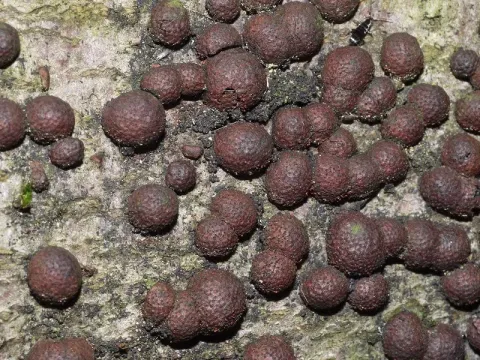
The fungus is characterized by the production of stromata, which are the visible reproductive structures that emerge through the bark of the host tree.
The name "strawberry-like" originates from the initial appearance of these stromata, which are bright red or orange and spherical when young.
As the fungus matures and prepares for spore dispersal, the stromata darken significantly, eventually turning into a dark brown or charcoal-black color.
The life cycle involves the release of ascospores into the environment, which rely on wind and rain to travel to new host sites or suitable damaged areas.
The most distinctive symptom is the appearance of numerous small, pimple-like growths on the bark of dead or weakened branches and trunks.
Initially, these growths are bright red, providing a striking contrast against the grey bark typically associated with beech trees.
As the infection progresses, the bark in the immediate vicinity of the stromata may become brittle, discolored, or start to detach from the wood.
- Bright red to orange spherical structures (stromata) on bark.
- Darkening of the stromata as the fungus matures.
- Formation of patches of necrotic tissue.
- Peeling bark exposing stained or decaying wood.
- Presence of black, powdery spore deposits on adjacent surfaces.
Diagnostic observation often reveals that the fungus prefers colonization on smooth-barked areas, where it can easily erupt through the surface.
Moist environments are essential for the survival and colonization of Hypoxylon fragiforme, as it thrives in high-humidity forest settings.
The fungus is considered a secondary colonizer, which means it typically infects trees that are already stressed by drought, storm damage, or competition.
Poor tree health caused by soil compaction or root damage provides the fungus with an entry point to attack the wood internally.
Temperature plays a role, with moderate spring and autumn temperatures being ideal for the development and spore production of the fungal body.
Reduced airflow in overcrowded stands prevents the bark from drying quickly after rain, thereby extending the duration of the colonization window.
The fungus causes white rot, a form of decay that breaks down both lignin and cellulose, significantly reducing the structural integrity of the wood.
While often found on dead wood, it can transition to a parasitic state, further weakening living beech trees that are struggling for resources.
The structural instability caused by the decay increases the risk of limb breakage, posing a safety hazard in public parks and managed forests.
In silviculture, the presence of this fungus is an indicator of poor tree vigor, which leads to long-term reduction in timber quality.
The infection process slowly consumes the sapwood, eventually leading to the death of the tree if the environmental stress continues unabated.
Effective management begins with rigorous forest hygiene, which includes the removal of dead or heavily infested branches to reduce spore load.
Minimizing mechanical injury to standing trees is crucial, as avoiding wounds prevents the fungus from accessing the inner wood layers.
Promoting the overall health and vigor of the stand through appropriate thinning helps trees resist colonization by secondary pathogens.
In managed landscapes, regular inspections are recommended to identify early stages of infestation before structural damage becomes severe.
There are no direct chemical treatments available for forest-scale application, making preventative silvicultural practices the most vital defense strategy.