
Description
Symptoms
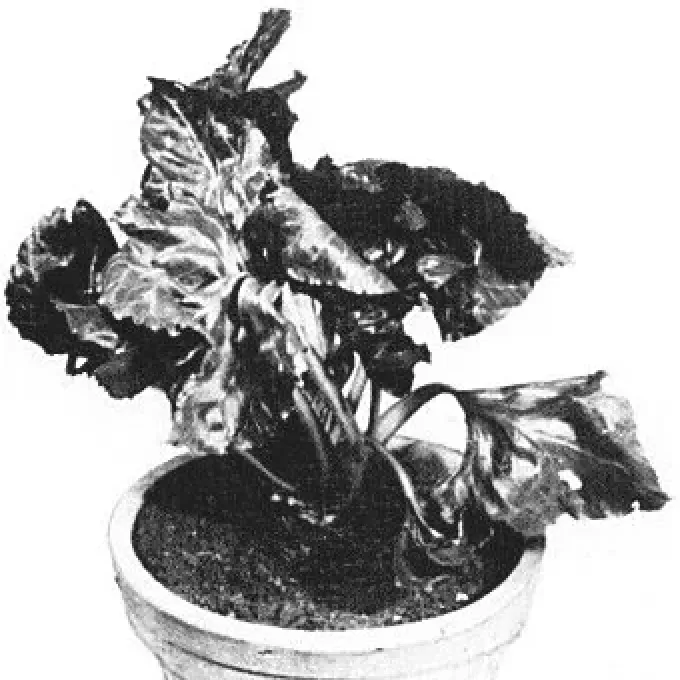
The primary symptom is severe leaf deformation, where leaves become small, crinkled, and form a dense, rosette-like cluster at the crown of the root.
Leaf petioles become significantly shortened, giving the plant a stunted and compressed appearance. The leaves often display abnormal chlorosis or yellowing, indicating impaired photosynthetic activity.
Upon examination, the root system shows signs of poor development and distortion. The growth of the storage root is severely inhibited, resulting in a dramatic loss of forage beet biomass.
Internal tissues of the root may show structural abnormalities, and in some cases, vascular browning occurs. Severely affected plants may wilt prematurely despite adequate soil moisture levels.
Symptom severity varies depending on the cultivar and the timing of infection. Early-season infestation generally leads to more pronounced developmental defects and complete crop failure in localized areas.
Pathogen
The disease is caused by specific microorganisms known as rickettsia-like organisms (RLO). These are obligate intracellular parasites that primarily colonize the phloem tissues of the host plant.
The infection targets species within the Beta genus, including forage beet, sugar beet, and red beet. In agricultural environments, the pathogen is transmitted by insect vectors, most notably leafhoppers that feed on plant sap.
Rickettsia-like organisms possess a cell wall but rely entirely on the host plant's metabolism for growth. Their reproduction within the phloem disrupts the normal translocation of photosynthates.
The infection is systemic, spreading throughout the plant's vascular system once the pathogen is introduced. It often exhibits a latent phase, making early field detection quite challenging.
The biology of these organisms remains difficult to study because they cannot be easily cultured in standard laboratory media, requiring specialized research techniques.
Conditions for development
The spread of the disease is closely linked to the population dynamics of insect vectors. Hot and dry weather conditions are known to favor the rapid reproduction and activity of leafhoppers.
Infection typically occurs when vectors migrate from weed reservoirs to beet fields. High vector pressure during critical growth stages significantly increases the risk of an epidemic.
The presence of perennial weeds near fields serves as a primary source of the pathogen, as these weeds can act as asymptomatic carriers for the rickettsia-like organisms.
Environmental stress factors, such as drought or heat, make the beet crop more susceptible to successful colonization by the pathogen upon transmission by the vector.
The geographic distribution of the disease is strictly determined by the presence of specific leafhopper species capable of transmitting the pathogen via their salivary secretions.
Why it matters
The main impact of the disease is a drastic reduction in total yield. Plants affected by rosette symptoms are unable to produce a viable, marketable, or nutritionally adequate root.
Nutritional quality decreases significantly, with lower sugar content, reduced dry matter, and fewer essential vitamins, making the crop less valuable for livestock feed.
Widespread infection within a field can lead to severe harvest losses, which can become economically critical during years with high insect vector populations.
Infected fields serve as continuous sources of inoculum, necessitating extra costs for phytosanitary measures, crop rotation adjustments, and increased pest management efforts.
Storage potential of the roots is also compromised, as infected plants are more vulnerable to secondary decay and opportunistic pathogens during winter storage.
Protection
The most effective management strategy involves rigorous control of insect vector populations. Timely application of systemic insecticides is essential to interrupt the transmission cycle.
Preventive measures include the systematic removal of weeds surrounding the fields, as these act as primary reservoirs for the pathogen and hibernation sites for leafhoppers.
Maintaining spatial isolation from fields previously hosting susceptible crops can help reduce the probability of pathogen introduction into new plantings.
The development and use of resistant beet cultivars remain a high priority for researchers, although breeding for resistance against RLO is a slow and complex process.
Cultural practices, such as ensuring optimal soil preparation for rapid and uniform germination, help the crop outgrow the most vulnerable early growth stages, thereby reducing the impact of potential early infections.
Pathogens and affected parts
Affects crops · 1
Discussion
No discussions yet — be the first.