
Description
Symptoms
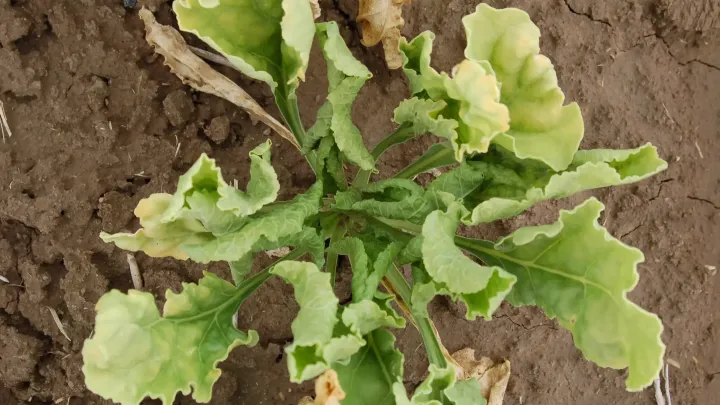
The initial symptoms are characterized by the clearing of small veins in the youngest leaves, followed by a inward curling of the leaves.
A distinctive feature is the thickening and swelling of the veins on the underside of the leaves. Leaves become stiff, brittle, and often show a dark, leathery appearance.
Infected plants exhibit severe stunting and reduced growth rates. In many cases, the growth of the central rosette is completely arrested.
Root systems often become deformed, showing a proliferation of hairy lateral roots, which is commonly referred to as a hairy root condition.
In field conditions, the disease is usually distributed in patches, reflecting the migration patterns and feeding activity of the leafhopper vector.
Pathogen
The causative agent of the disease known as beet curly top is the Beet curly top virus (BCTV). This virus is a serious pathogen that negatively affects the development of various crops.
The virus is transmitted by a specific vector, the beet leafhopper. The insect acquires the virus after feeding on the phloem of infected host plants.
Once inside the plant, the virus moves through the vascular system, causing systemic infection and disrupting the movement of essential nutrients.
The pathogen has a wide host range, including sugar beet, fodder beet, tomatoes, peppers, and beans, making it a significant threat to diverse agricultural systems.
The virus overwintering occurs primarily in wild weeds and annual plants, which serve as reservoirs for both the virus and the leafhopper populations.
Conditions for development
The development of the disease is highly correlated with warm, dry weather patterns. These conditions are optimal for the rapid population growth of leafhoppers.
Leafhopper migration is triggered when native host plants dry out during drought periods, driving the insects toward lush, irrigated, or managed crops like beet.
Late planting is a significant risk factor, as young plants are highly susceptible to the virus during their initial growth stages when they have fewer defenses.
Poor field hygiene and the presence of abundant weeds provide the perfect environment for the virus to persist and for the leafhoppers to multiply.
Climatic factors that support early-season movement of the leafhoppers increase the probability of early infection, leading to more severe crop losses.
Why it matters
Beet curly top causes substantial economic losses by significantly reducing crop yields and quality, especially in sensitive fodder beet varieties.
Infected roots are often stunted and misshapen, making them less suitable for feed and decreasing their storage longevity in silos or piles.
The physiological stress caused by the virus affects the overall nutritional quality of the fodder, leading to lower energy values for livestock consumption.
- Severe reduction in total harvest biomass.
- Deformation and loss of quality in root crops.
- Increased susceptibility to secondary soil-borne pathogens.
- Higher management costs due to insecticide applications.
The disease's unpredictability from year to year creates challenges for agricultural planning and ensuring consistent fodder supplies for livestock.
Protection
The most effective management strategy is to adjust planting dates to avoid the peak flight period of the leafhopper vectors, allowing plants to mature safely.
Utilizing resistant or tolerant beet varieties is the cornerstone of effective disease management and is crucial for reducing the impact of BCTV.
Rigorous weed control in and around field boundaries is essential to eliminate the natural reservoirs where both the virus and its vectors persist.
Systemic insecticides applied as seed treatments or early foliar sprays can provide critical protection during the early phases of plant development.
Maintaining proper field density and crop rotation helps to minimize the localized spread of the virus and keeps the environmental stress on crops at a minimum.
Pathogens and affected parts
Affects crops · 1
Discussion
No discussions yet — be the first.