
Description
Symptoms
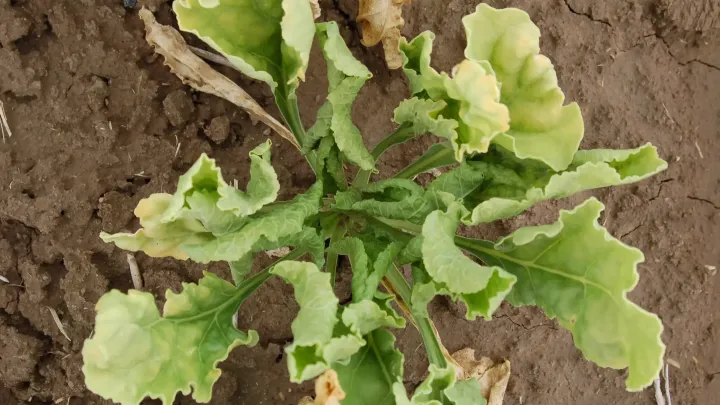
Initial symptoms include the clearing of veins on young leaves, followed by characteristic inward curling and thickening of the leaf tissue.
Leaves often become leathery, brittle, and darker green than healthy foliage, with significant deformation of the plant's overall architecture.
Stunted growth is a hallmark of the disease, often accompanied by the proliferation of secondary roots, leading to a hairy root appearance in beets.
In crops like beans and spinach, the plants may turn yellow, stop growing, and fail to produce viable fruit or foliage suitable for consumption.
Infection often occurs in patches within a field, reflecting the landing patterns and feeding behavior of the migrating leafhopper populations.
Pathogen
Beet curly top is caused by the Beet curly top virus (BCTV), which belongs to the genus Curtovirus and the family Geminiviridae.
The virus is transmitted by the beet leafhopper (Circulifer tenellus), a small insect that feeds on the phloem of host plants.
BCTV is not mechanically transmissible, meaning it cannot spread through plant contact or contaminated tools, only through the specific insect vector.
The host range of the virus is exceptionally wide, affecting numerous crops including sugar beets, common beans, spinach, watermelons, tomatoes, and peppers.
Once a leafhopper acquires the virus from an infected plant, it remains a carrier for the rest of its life, effectively spreading the pathogen as it migrates.
Conditions for development
The development and severity of the disease are highly dependent on weather patterns that influence leafhopper migration.
Hot, arid conditions favor the population growth of beet leafhoppers and stimulate their migration from dried-up rangeland weeds to irrigated fields.
The lack of alternative food sources during drought forces the insects to colonize agricultural crops, leading to significant outbreaks.
Mild winters facilitate the survival of both the host weeds and the leafhoppers, creating a higher risk for infection early in the growing season.
The timing of the migration relative to the crop's development stage is the most critical factor determining the economic impact of an outbreak.
Why it matters
Beet curly top is one of the most destructive viral diseases for sugar beet and various vegetable production systems.
Severe infections result in significant yield losses, often causing total crop failure if the plants are infected at a very young, vulnerable stage.
For sugar beets, the virus drastically lowers the sugar content, rendering the crop economically non-viable for industrial processing.
Vegetable crops like watermelons and spinach may become completely unmarketable due to severe stunting, leaf distortion, and lack of fruit development.
The disease poses a constant threat to growers, necessitating intensive management of the insect vector to prevent widespread field destruction.
Protection
Control strategies focus primarily on managing the beet leafhopper population through the timely application of systemic insecticides.
Cultural practices, such as removing host weeds in and around fields, are essential to eliminate the virus's reservoirs and insect breeding grounds.
Using resistant or tolerant cultivars is the most effective long-term strategy for managing the disease and reducing reliance on chemical pesticides.
Physical barriers, such as row covers or agricultural fleece, can provide effective protection for young seedlings during peak leafhopper migration periods.
Adjusting planting dates to avoid the peak flight times of the leafhoppers can also help reduce the incidence of infection in susceptible crops.
Pathogens and affected parts
Affects crops · 3
Discussion
No discussions yet — be the first.