
Beech Russula
Russula fellea
Description
Symptoms
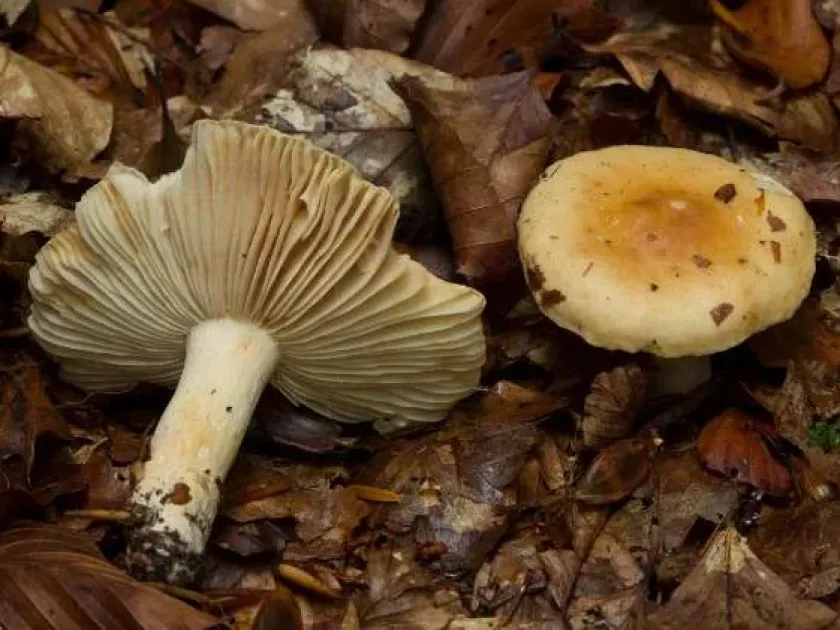
The fruit bodies of the Beech Russula are characterized by a distinct honey-yellow or straw-yellow color. The caps are convex at first, eventually becoming depressed or funnel-shaped at maturity.
The gills are crowded and adnate, colored similarly to the cap. The stem is solid and relatively tough when young, but it tends to soften as the mushroom ages.
The most diagnostic feature is the intensely bitter and acrid taste of the flesh, which makes it inedible for humans. It also emits a subtle, fruity or apple-like odor.
The spore print is pale cream in color. Microscopic analysis of the spores reveals specific surface patterns typical of the Russula genus, confirming its taxonomical placement.
No typical symptoms of plant infection, such as lesions, wilting, or tissue degradation, appear on the trees associated with this fungus, which confirms its non-pathogenic nature.
Pathogen
The Beech Russula (Russula fellea) is a mushroom belonging to the Russulaceae family. It is frequently misidentified as a plant pathogen; however, in biological terms, it is a beneficial mycorrhizal fungus rather than a disease agent.
The organism does not cause any infections, blights, or rots in crops or forest trees. Its primary role is to form symbiotic associations with the root systems of trees, primarily beeches and oaks, facilitating nutrient exchange.
It lacks the enzymes necessary to penetrate or kill living plant tissues. Consequently, it does not function as a parasite and poses no risk to agricultural health or silvicultural productivity.
As a mycorrhizal fungus, it operates within the rhizosphere. The mycelium acts as an extension of the tree roots, increasing the surface area for the uptake of water and essential mineral elements from the soil.
Classifying this species as a plant disease is a misunderstanding of its ecological function. It contributes to tree resilience by strengthening the subterranean ecological network within forests.
Conditions for development
This fungus typically thrives in deciduous forests, specifically those dominated by beech or oak trees. It prefers acidic soils with deep layers of organic leaf litter.
The optimal period for fruit body development ranges from late summer through autumn, coinciding with periods of high rainfall and moderate temperatures that favor fungal growth.
The survival and propagation of Russula fellea depend on the health of the host tree’s root system. Without the symbiotic host, the fungus cannot complete its lifecycle.
Environmental stability, such as consistent moisture levels and minimal soil disturbance, is essential for the mycelial network to persist in the forest floor throughout the year.
Spore dispersal relies on air currents, allowing the species to colonize suitable forest habitats where its specific tree partners are already established.
Discussion
No discussions yet — be the first.