
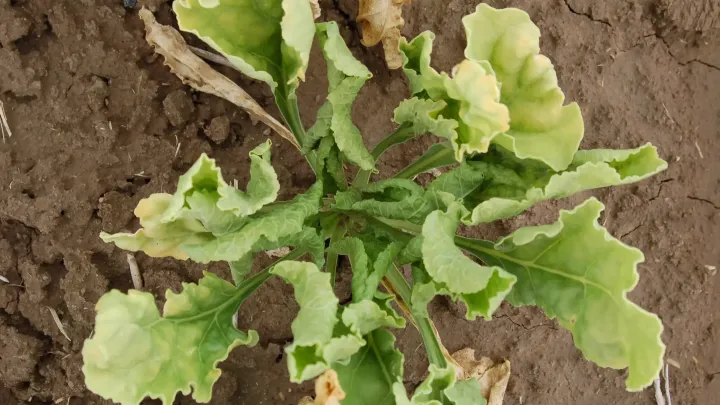
Description
Symptoms
The initial symptom of infection is the inward rolling and yellowing of young leaves at the center of the crown, which gives the plant a characteristic curly appearance.
The veins on the underside of the leaves often become swollen and darkened, showing a bumpy or necrotic texture that is highly indicative of the virus's presence.
Stunting is a major feature of the disease. Infected plants stop growing, remain small, and exhibit a significant reduction in overall biomass compared to healthy neighboring plants.
Root development is severely impaired, often resulting in a stunted primary root accompanied by an excessive proliferation of small, hairy lateral roots.
The foliage becomes stiff and brittle due to the accumulation of carbohydrates that the plant cannot properly transport to the roots, leading to physiological collapse.
Pathogen
Beet curly top is a severe systemic disease caused by the Beet curly top virus (BCTV). It affects a wide range of host plants, including sugar beet, fodder beet, peppers, tomatoes, tobacco, and many others.
The virus is phloem-limited and does not spread through seeds or mechanical contact. Instead, it relies entirely on its vector, the beet leafhopper (Circulifer tenellus), for transmission between hosts.
When a leafhopper feeds on an infected plant, it acquires the virus and becomes a vector for life, capable of transmitting it to any subsequent host plant it visits.
With over 300 susceptible plant species, the virus finds a permanent reservoir in weed populations, which allows it to persist in the environment throughout the entire year.
The movement of these viruliferous leafhoppers from wild host plants to agricultural fields is the primary cause of sudden and widespread disease outbreaks in crops.
Conditions for development
Disease prevalence is heavily dependent on the population dynamics of the beet leafhopper, which thrives in hot, arid climates and drought-stricken areas.
High temperatures accelerate both the development of the leafhopper and the transmission efficiency of the virus, leading to more aggressive outbreaks.
The disease is most damaging when young seedlings are infected, as they possess the least amount of natural resistance to the systemic stress caused by the virus.
Migration events, often triggered by the drying up of native vegetation, cause massive numbers of insects to swarm into irrigated fields where they seek succulent host plants.
Lack of rainfall in the spring and early summer often serves as a precursor to severe curly top outbreaks, as it dries out the natural reservoirs and forces the vectors to move.
Why it matters
The impact of Beet curly top on crop yield is devastating, with losses in sugar beet fields frequently exceeding 50-80% in high-pressure years.
In addition to volume loss, the quality of the beet is compromised; the sugar content decreases significantly, making the crop less profitable for processors.
Infected stands often show severe thinning, as many plants fail to survive the initial stages of the viral infection, often requiring complete field replanting.
Secondary infections, including various types of root rot, often settle in weakened plants, further reducing the marketability and storage potential of the harvest.
Farmers face significant economic hardship due to the dual cost of lost yields and the intensive expenditure required for vector control measures throughout the season.
Protection
The most effective strategy involves intensive management of the beet leafhopper population using systemic insecticides during the early stages of crop growth.
Cultural practices are essential; removing weeds around field margins helps eliminate the reservoir hosts that keep the virus circulating in the local environment.
Strategic timing of planting is crucial to ensure that plants are past their most vulnerable growth stages before the peak seasonal migration of the vectors occurs.
- Utilizing resistant or tolerant crop varieties where available.
- Creating buffer zones to discourage leafhopper migration into the field.
- Monitoring insect populations with yellow sticky traps to trigger control actions.
Integrated Pest Management (IPM) is required, as no single method provides complete immunity; combining chemical and cultural controls is the industry standard.
Pathogens and affected parts
Affects crops · 3
Discussion
No discussions yet — be the first.