
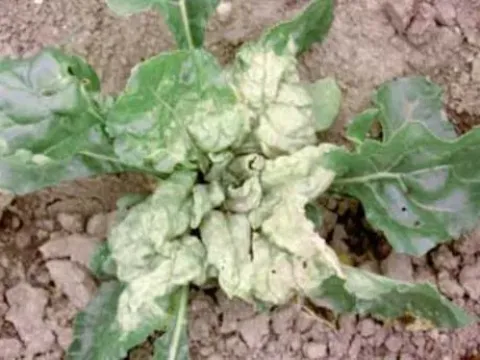
Beet curly top
Beet leaf
The causative agent of this disease is the Beet curly top virus (BCTV). It is a plant-pathogenic virus that infects the vascular system of various dicotyledonous plants.
What the section contains
Beet curly top
The virus is transmitted by insect vectors. It does not survive in the soil but persists in alternative host plants, particularly wild weeds, during the off-season.
The primary vector responsible for the transmission of BCTV is the beet leafhopper (Circulifer tenellus). Once the leafhopper feeds on an infected plant, it carries the virus for the remainder of its life.
The virus has a very broad host range, including forage beets, sugar beets, tomatoes, beans, and various cucurbits, making it difficult to manage in diverse landscapes.
Upon infection, the virus enters the phloem, causing systemic infection that restricts nutrient transport, which ultimately leads to the classic symptoms of the disease.
The earliest symptom is the inward curling of young leaves, which often become thickened, leathery, and brittle to the touch as the disease progresses.
A distinctive sign of curly top is the "vein clearing," which is the yellowing of the veins on the underside of the leaves, visible upon close inspection.
Infected plants exhibit severe stunting, with internodes becoming shortened, leading to a stunted growth habit that makes the plant look bushy and compressed.
The root system of infected beets shows abnormal development, often characterized by the proliferation of excessive lateral roots, commonly described as "hairy root."
As the plant ages, the leaves may turn a dull, sickly yellow, and the entire plant may collapse or die if infection occurs during the early seedling stage.
Hot and dry climatic conditions are the most critical factors for disease development, as they favor the rapid reproduction and migration of beet leafhoppers.
When wild vegetation in arid areas dries out, leafhoppers migrate in large numbers into irrigated agricultural fields, carrying the BCTV pathogen with them.
High temperatures accelerate the viral replication cycle within the plant tissues, leading to a faster and more severe manifestation of disease symptoms.
Lack of proper field management, such as the accumulation of weeds, provides a vital reservoir for the virus and the insect vector population throughout the year.
The disease is most prevalent in regions with seasonal shifts in rainfall, which drive the movement of insect populations from desert areas toward cultivated fields.
Beet curly top is highly damaging to forage beet production, as it can cause significant reductions in both foliage and root biomass yields.
The quality of the forage beet is severely degraded, as the stunted roots have lower nutritional density, making them less suitable for livestock consumption.
Systemic infection weakens the plant's overall physiology, making it highly susceptible to secondary attacks from other pathogens and environmental stressors.
Economic losses arise from both reduced production and the high costs associated with repeated insecticide applications needed to manage the leafhopper vector.
If the infection occurs early in the growing season, entire fields may need to be replanted, causing total failure of the initial agricultural investment.
The management of curly top focuses primarily on controlling the beet leafhopper population through the strategic application of systemic insecticides.
Sanitation practices, including the eradication of weed hosts around field margins, are essential to minimize the source of the virus in the environment.
Planting dates can be adjusted in some regions to avoid the peak periods of leafhopper migration, allowing the beets to reach a more resistant growth stage.
Integrated Pest Management (IPM) strategies, including the use of yellow sticky traps for monitoring leafhopper numbers, are recommended for timely intervention.
- Apply systemic insecticides to manage leafhopper populations.
- Control weed reservoirs along field boundaries and irrigation ditches.
- Use resistant or tolerant cultivars where available.
- Monitor vector populations to time chemical control measures.