
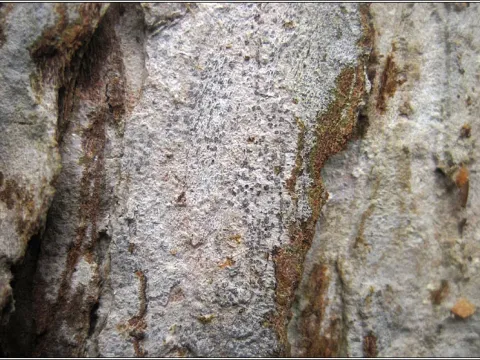
Schismatomma decolorans
Schismatomma decolorans
Schismatomma decolorans is a species of epiphytic lichen that settles on the bark of older trees. This organism is a symbiotic complex of a fungus and an alga and is not a pathogen in the traditional sense, as it does not cause infectious plant diseases.
What the section contains
Schismatomma decolorans
Biologically, this organism belongs to the lichen group, which uses the bark surface solely as a substrate for attachment. The fungal component provides protection and moisture retention, while the photobiont (algae) carries out photosynthesis.
Unlike parasitic fungi, this lichen does not penetrate the living tissues of the tree or feed on its sap. Its presence on trunks and branches is an indicator of high air humidity and specific microclimatic conditions in a particular garden or park area.
The structure of the thallus of Schismatomma can vary depending on environmental factors, but it usually exhibits a grayish-white shade. The growth of this organism is extremely slow, allowing it to remain in the same location for decades.
The epiphytic lifestyle makes this species an indicator of air quality, as lichens are sensitive to atmospheric pollution levels, particularly sulfur dioxide. Its presence often signals a favorable ecological environment, although its appearance on garden plants may cause concern for owners.
Visually, Schismatomma decolorans manifests as flat or slightly granular patches on the tree bark. The color of the thallus most often varies from whitish to ash-gray, which is reflected in its common and scientific names.
Lesions are most frequently localized on the northern or shaded side of the trunk, where moisture is retained for the longest periods. The thallus can adhere tightly to the bark, forming characteristic patterns that resemble maps or intricate layering.
Upon closer inspection, one may notice apothecia—the fruiting bodies of the fungal component—which appear as tiny dark dots or pits. Their presence confirms the maturity of the colony and its ability to reproduce via spores.
As they gradually expand, lichen colonies may merge, covering significant areas of bark. This often creates the impression of bark discoloration or necrosis, although the bark beneath the lichen typically remains intact and healthy.
It is important to distinguish this lichen from actual fungal bark diseases. Unlike the latter, Schismatomma does not cause the formation of weeping spots, deep cracks, gummosis, or rot within the wood fibers.
The primary factor for the development of Schismatomma is high relative humidity. This is why the organism is most often found in old orchards with dense canopies where air circulation is restricted.
The regional temperature regime plays a secondary role, as the lichen is capable of withstanding significant temperature fluctuations. More critical is the presence of a constant moisture source, such as proximity to water bodies, dense forests, or stagnant air zones.
Old trees with rough, slowly shedding bark provide an ideal substrate for lichen colonization. On young trees with smooth bark, Schismatomma is rarely found, as the intensive growth of the trunk disrupts the colonies.
Light exposure is also critical for the formation of dense populations. Shaded parts of the canopy, where the bark is not overheated by direct sunlight, create the optimal conditions for algal activity within the lichen.
Lack of regular orchard maintenance, such as trunk cleaning and pruning, contributes to the accumulation of organic debris and dust, which further supports the development of epiphytic communities on the trunks.
Direct damage to the culture from the presence of Schismatomma is minimal, as it does not consume the plant's nutrients. However, massive lichen development can indirectly negatively affect the tree's overall condition.
Dense colonies may hinder natural bark gas exchange, somewhat impeding the respiration of woody tissues. In high-humidity conditions, the space beneath the thallus can harbor spores of true pathogenic fungi and various pests.
Lichens often serve as shelters for overwintering stages of harmful insects, such as scale insects or mites. Thus, a tree densely covered in lichen can become a reservoir for garden pests.
Aesthetically, the presence of lichen on fruit trees reduces the garden's visual appeal and may indicate a general weakening of the tree due to age or lack of care. This acts as a signal for the gardener to initiate rejuvenation measures.
In exceptional cases, where trunk coverage becomes total, excessive bark moisture may occur, which, combined with a lack of ventilation, creates a favorable environment for secondary bacterial infections.
The best method for managing lichens is mechanical bark cleaning. This should be performed in spring or autumn during damp weather, using wooden or plastic scrapers to avoid damaging the living cambium tissues.
After cleaning, it is recommended to whitewash the trunks and main branches with lime milk mixed with copper sulfate. This effectively disinfects the bark surface and prevents re-colonization by lichens.
Sanitary pruning is a key preventive measure. Thinning the canopy improves air circulation and sunlight penetration, making conditions on the branch surfaces inhospitable for lichen growth.
Regular watering and fertilization promote rapid bark growth, which also prevents lichen spores from establishing themselves. A healthy, actively growing tree can partially self-clean through the natural shedding of old bark.
The application of copper-based fungicides is highly effective, as lichens possess a high sensitivity to copper ions. Treatments should be carried out in the early spring period before the buds begin to open.