
Downy mildew of buckwheat
Peronospora cristata
Description
Symptoms
The first symptoms appear on the leaves as light or yellowish blurry spots that eventually turn brown. Over time, tissue necrosis occurs in the affected areas.
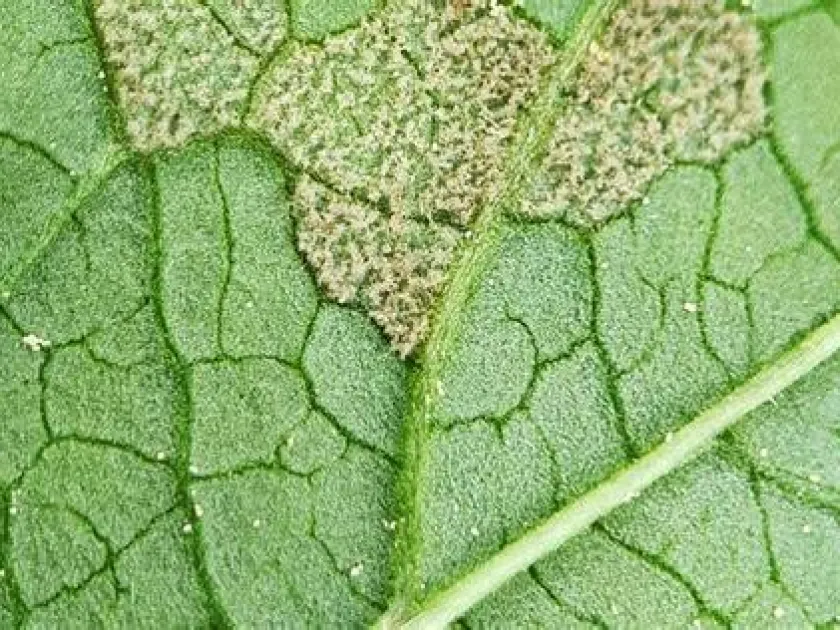
On the underside of the leaves, within the infected zones, a greyish or violet-colored mildew growth appears. This is the fungus's sporulation, which is most visible during humid, misty mornings.
As the infection progresses, the affected leaves wither and die. Severe infestations lead to premature leaf drop, which significantly reduces the plant's total photosynthetic surface area.
The disease can also affect stems and inflorescences, leading to the deformation of reproductive organs. Affected flowers often fail to set seeds or produce thin, undersized grains.
Overall, the plants appear stunted, chlorotic, and weak. The typical disease progression starts from the lower canopy and gradually spreads to the upper parts of the plant.
Pathogen
The causal agent of this disease is the oomycete Peronospora cristata. It is a highly specialized pathogen that exclusively affects plants of the Polygonaceae family, including the common buckwheat.
This fungus is an obligate parasite, meaning it relies entirely on living host tissues to complete its biological cycle. The pathogen overwinters as oospores, which remain viable in crop residues or on seed surfaces.
When environmental conditions are favorable, oospores germinate and produce sporangia. These are then dispersed by wind currents or water droplets, initiating primary infection on young buckwheat seedlings.
The life cycle involves the production of conidia throughout the growing season, facilitating multiple infection cycles. Under optimal conditions, the pathogen can spread rapidly across a field.
The biology of Peronospora cristata is strongly linked to moisture availability. High humidity and leaf wetness are critical for the formation of spores and the successful infection of healthy buckwheat tissues.
Conditions for development
Downy mildew thrives in conditions of high humidity and moderate temperatures. The optimal range for active sporulation is between 15 and 20 degrees Celsius with relative humidity exceeding 80%.
Frequent fog, heavy dew, and prolonged rainy periods during the first half of the buckwheat growth cycle create an ideal microclimate for the rapid spread of the pathogen.
Dense crop stands, where air circulation is restricted, trap moisture on the leaves for longer durations, significantly increasing the risk of widespread disease development.
Poor crop rotation practices, such as planting buckwheat too frequently on the same soil, lead to a high accumulation of infectious oospores in the field, increasing the likelihood of early infection.
Excessive nitrogen fertilization promotes succulent vegetative growth, which is more susceptible to the penetration of fungal hyphae, making the plants easier targets for Peronospora cristata.
Why it matters
The primary damage caused by downy mildew is the significant reduction in photosynthetic capacity, which directly leads to stunted growth and reduced vegetative biomass.
The disease negatively impacts reproductive development. Due to metabolic disturbances, flower abortion is common, leading to a substantial decrease in grain yield per plant.
Seed quality is severely compromised, resulting in shriveled and lightweight grain. This lowers the commercial value of the crop and negatively impacts its germination vigor for future use.
In epidemic years, yield losses can reach 30% or more, making buckwheat production economically unstable if not managed properly.
Furthermore, weakened plants become more susceptible to secondary pathogens and abiotic stresses, further exacerbating the degradation of the crop stand.
Protection
The cornerstone of disease management is strict adherence to crop rotation. A gap of 3–4 years between buckwheat crops is essential to reduce the infectious load in the soil.
Seed treatment with authorized fungicides is mandatory to disinfect the seed material and provide protection to young seedlings against early-season infection.
Field hygiene is also crucial. Controlling weeds and buckwheat volunteers is necessary, as they can act as reservoirs for the pathogen throughout the growing season.
Balanced fertilization, particularly with potassium and phosphorus, enhances the mechanical strength of cell walls, making it harder for the pathogen to penetrate plant tissues.
- Utilizing disease-resistant buckwheat varieties
- Deep plowing to bury infected crop residues
- Optimizing seeding rates to ensure better aeration of the canopy
- Application of foliar fungicides at the first sign of symptoms
Discussion
No discussions yet — be the first.