
Downy mildew of cereals
Sclerophthora macrospora
Description
Symptoms
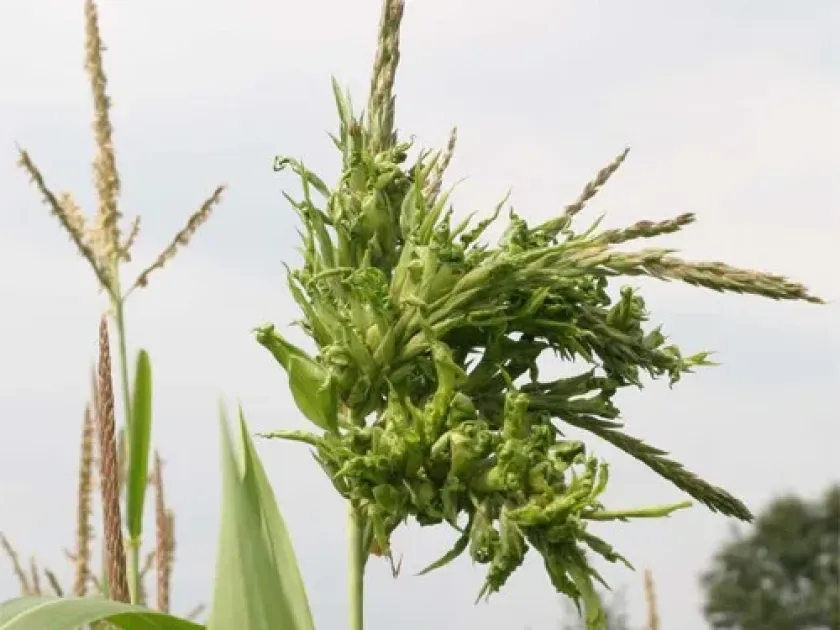
The most characteristic symptom of downy mildew is severe plant deformation. Stems often become thickened, twisted, and stunted, with excessive tillering giving the plant a distinctive "broom-like" or "witches' broom" appearance.
Leaves may show yellow or chlorotic longitudinal streaks. In severe cases, the entire plant appears dwarfed and exhibits a deep green or yellowed color, depending on the severity of the systemic infection.
Infected plants frequently fail to head properly. If an ear is produced, it is often deformed, shriveled, or sterile. The floral parts can be replaced by distorted leaf-like structures, a symptom known as phyllody.
Root development is typically retarded, leading to overall plant weakness and susceptibility to moisture stress. On older stalks, the tissue might soften or rot due to the mass formation of spores inside the stalks.
Field patches with stunted, chlorotic, and malformed plants are a clear indication of a Sclerophthora macrospora outbreak. These patches are most visible during the elongation and heading stages of the crops.
Pathogen
The causal agent of this disease is the oomycete Sclerophthora macrospora, which belongs to the Peronosporales order. This pathogen primarily attacks cereal crops, overwintering in the soil and crop residues in the form of highly resilient oospores.
The fungus develops systemically within the host plant, infiltrating intercellular spaces and the vascular system. Unlike many other fungal diseases, this pathogen often affects the plant during the early seedling stages, leading to permanent structural changes.
The biological cycle of the pathogen is strictly dependent on moisture. For the oospores to germinate and release motile zoospores, free water in the soil or on the plant surface is required, which explains the disease's correlation with flooded or waterlogged conditions.
Zoospores are equipped with flagella, allowing them to swim through water films to reach the roots or the stem bases of susceptible plants. This ability to move through water makes the pathogen particularly dangerous in low-lying areas.
The pathogen can survive in soil for several years, making long-term field management necessary. It hosts on a wide variety of cereal crops, including wheat, barley, oats, and rye, as well as many wild grass species.
Conditions for development
The primary driver for disease development is excessive soil moisture or flooding. Field sites that remain waterlogged for prolonged periods are prime targets for infection by zoospores.
Optimum temperatures for infection range from 15°C to 20°C (59°F to 68°F). During these conditions, the pathogen is most active, rapidly producing and dispersing zoospores across the field.
Heavy clay soils that are prone to puddling and poor aeration facilitate the pathogen's spread. These soils provide the essential aquatic environment needed for the motile spores to reach the host plants.
Wild grass weeds in and around the field act as secondary reservoirs for the infection. These weeds can sustain the pathogen even when the primary cereal crop is not present, ensuring a persistent infection source.
Poor agronomic practices, such as shallow planting or excessive soil compaction, can weaken initial germination and root health, making the seedlings more vulnerable to colonization by the oomycete.
Why it matters
Downy mildew causes significant economic losses by severely reducing grain yield. Plants affected by the systemic fungus rarely produce viable grain, leading to patches of total crop failure.
The damage is not limited to yield quantity; the quality of the harvested grain is also compromised if the crop matures unevenly. The disease also renders the straw less valuable for feed or industrial use.
Infected plants act as nutrient sinks, competing for space, light, and resources with healthy crops, while failing to contribute to the overall farm productivity.
Severe infestations may force farmers to abandon the crop in the affected area, necessitating costly reseeding or resulting in permanent loss of seasonal income for that plot.
Since the pathogen persists in the soil, the presence of the disease limits land-use options for several years, requiring careful planning to manage the disease-conducive environment.
Protection
The most effective strategy is a robust crop rotation program that excludes susceptible cereals for at least 3–4 years. This allows the oospore population in the soil to naturally decline to manageable levels.
Improvement of field drainage and land leveling are critical to prevent water stagnation. By managing water flow, the farmer removes the essential medium required for the pathogen's life cycle.
Aggressive weed management, particularly targeting grass weeds like couch grass or foxtail, is essential to reduce the reservoir of infection within and around the field.
- Selection of resistant or tolerant cultivars for high-risk areas.
- Use of certified, disease-free seed and preventative fungicide seed treatments.
- Balanced fertilization to ensure rapid, vigorous growth that can help seedlings overcome early pressure.
- Deep plowing or moldboard plowing to bury infected residues and reduce the pathogen's ability to survive.
Chemical control during the growing season is rarely effective once systemic infection has occurred. Therefore, focus must remain on preventative cultural practices and maintaining optimal soil drainage conditions.
Discussion
No discussions yet — be the first.