
Apple scab
Fusicladium obducens
The causative agent of apple scab is the fungus Fusicladium obducens (also commonly known as Venturia inaequalis in its conidial stage). This pathogen is highly specialized, primarily affecting trees in the Rosaceae family.
What the section contains
Apple scab
The life cycle of the pathogen occurs in two phases: a parasitic stage on living plant organs and a saprotrophic stage on fallen leaves. The fungus overwinters in the leaf litter, where it forms pseudothecia.
In spring, during favourable weather conditions, ascospores are released into the air and spread by wind or rain splashes onto young leaves. This marks the primary infection event of the season.
During the growing season, the fungus spreads via conidia produced on the infected spots. This process can repeat multiple times, leading to severe outbreaks if wet weather persists throughout the summer.
The pathogen shows high evolutionary potential and can adapt to various environmental conditions, making long-term orchard management a challenging task for growers worldwide.
The first signs of infection appear on expanding leaves as small chlorotic spots, which eventually develop a characteristic olive-brown, velvety coating. This coating is composed of the fungus's spores.
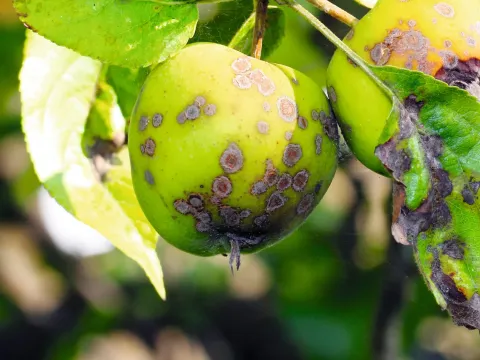
On fruit, scab manifests as dark, well-defined spots with a velvety texture. As the apples grow, the infected tissue stops developing, leading to cracking, deformations, and corky scab spots on the skin.
Infection of shoots is less common but more dangerous, as it leads to the formation of bark ulcers. These lesions can cause shoot dieback and significantly reduce the overall winter hardiness of the tree.
Early infections can affect blossoms and fruitlets, leading to widespread fruit drop. This can cause significant yield losses long before the harvest season begins.
The velvety olive-brown spores are the main diagnostic feature of the disease, allowing for clear identification of the fungal growth even in the early stages of infection.
The development of apple scab is heavily dependent on moisture. Prolonged rainfall, high humidity, and moderate temperatures (15-20°C) are ideal for spore germination and infection.
Poorly ventilated tree canopies with dense foliage create a humid microclimate that fosters pathogen spread. Lack of proper pruning is a major factor contributing to the severity of scab infections.
Trees that are weakened by improper irrigation or imbalanced nutrient levels, especially those with excessive nitrogen fertilization, tend to show higher susceptibility to the infection.
The presence of unremoved leaf litter in the orchard is the primary source of primary inoculum. Removing or shredding these residues is essential to break the pathogen's life cycle.
The incubation period lasts from one to two weeks depending on the temperature. Understanding this window is crucial for timing fungicide applications effectively.
The primary damage is a severe reduction in fruit quality and market value. Scab-affected apples are unappealing and prone to secondary infections, such as storage rots.
Extensive leaf infection reduces the photosynthetic capacity of the tree. This leads to weakened trees, poor fruit bud formation for the following year, and irregular bearing cycles.
In humid seasons, uncontrolled outbreaks can destroy up to 90% of the harvest. This creates major economic losses due to the necessity of intensive chemical control programs.
Damage to the bark and shoots reduces the tree's overall vigor and resistance to cold temperatures. In severe cases, it can lead to the death of major branches or entire young trees.
The cumulative effect of the disease is a significant decrease in orchard productivity and longevity, necessitating higher input costs for maintenance and protection.
Sanitation is the cornerstone of control: clearing and destroying fallen leaves in autumn drastically reduces the amount of overwintering inoculum in the orchard.
Regular pruning and canopy management ensure better airflow and light penetration, which helps leaves dry faster after rain, thereby limiting infection opportunities.
The chemical control program involves preventive fungicide applications during critical growth stages. Rotating different classes of fungicides is vital to manage resistance development.
- Planting scab-resistant apple cultivars.
- Applying contact fungicides to prevent infection.
- Using systemic fungicides for curative purposes during risk periods.
- Ensuring balanced mineral fertilization and tree health.
Modern integrated pest management strategies prioritize the use of resistant varieties, which significantly lowers the dependency on chemical sprays and improves overall sustainability.