
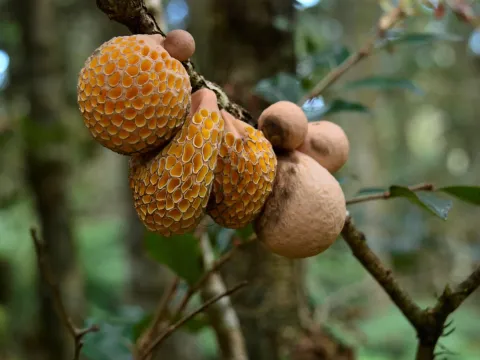
Cyttariaceae
Cyttariaceae
The disease is caused by fungi belonging to the family Cyttariaceae, within the order Helotiales. The genus Cyttaria is the primary pathogen associated with this condition.
What the section contains
Cyttariaceae
These fungi are obligate parasites that live in a strict biological relationship with trees of the Nothofagus genus (Southern beech).
The mycelium colonizes the host's wood and stimulates the production of hypertrophied tissues, which are essential for the fungal life cycle.
Spore production occurs within complex, specialized fruiting bodies that emerge on the bark surface. These structures are often distinct and easily visible.
The pathogen is highly host-specific, having evolved over millions of years to thrive exclusively on specific species of Southern beech in the Southern Hemisphere.
The most prominent sign is the development of large, woody galls on the branches and trunks of the infected trees. These growths can be quite substantial in size.
During the active season, the galls produce fleshy, often orange or yellow, fruit-like bodies. These are the reproductive structures of the fungus.
Bark cracking is common around the site of the infection, which often exposes the inner tissues to other opportunistic pathogens.
Branches suffering from heavy gall infestation may become deformed or bent due to the weight and abnormal growth patterns induced by the fungus.
In cases of severe infection, leaf chlorosis and premature leaf drop can occur, signaling a disruption in the tree's nutrient transport system.
The development of Cyttariaceae requires the presence of host trees from the Nothofagus genus, primarily in temperate forests of South America and Australia.
High humidity and rainfall are critical for the dispersal of fungal spores and for their successful germination on the host's bark.
Infection usually initiates through small wounds or cracks on the surface of the bark, where spores can settle and penetrate the underlying tissues.
Cooler, humid seasons provide the perfect environment for the rapid expansion of fungal fruiting bodies and subsequent spore release.
Dense forest stands with susceptible tree species allow for easier transmission of the pathogen through wind and rain splash.
The primary damage includes reduced tree vitality and structural instability caused by large galls, which can lead to branch failure during storms.
Significant internal deformation of the wood quality makes infected trees less valuable for timber production in commercial forestry.
The fungus acts as a long-term parasite, continuously draining the tree's resources, which leads to stunted growth and lower competitive ability.
The open wounds created by the fungus serve as entry points for rot-causing microorganisms, further compromising the structural integrity of the tree.
In extreme cases, persistent heavy infection can lead to the slow decline and death of the host tree, particularly in stressed environments.
Management focuses on sanitation, including the careful removal and destruction of heavily infested branches to reduce local spore populations.
Proper disinfection of pruning tools is essential to prevent the cross-contamination of healthy trees within the forest stand.
Choosing and planting resistant genotypes or species of Nothofagus is the most sustainable long-term approach to controlling the disease.
Minimizing physical damage to trees during logging or maintenance operations helps prevent new infection sites from forming.
Regular monitoring of forest health helps in early detection of outbreaks, allowing for localized management before the disease becomes widespread.