
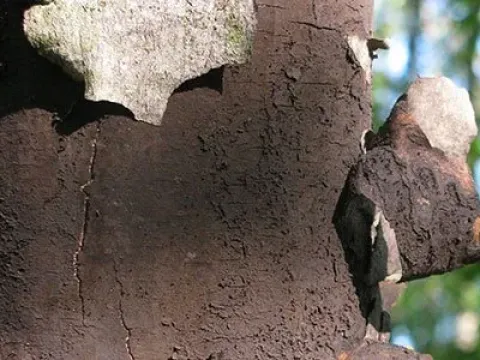
Sooty bark disease of maple
Cryptostroma corticale
The causative agent of the disease is the fungus Cryptostroma corticale. It is a pathogen that specifically attacks the bark and sapwood of maple trees, particularly Sycamore maple.
What the section contains
Sooty bark disease of maple
This fungus behaves as a latent endophyte, which means it exists within the host tissue without causing damage under normal conditions. It turns pathogenic only when the tree is subjected to severe environmental stress.
The fungal biology involves the production of extensive spore masses beneath the periderm of the tree. These spores are released when the bark cracks, facilitating the rapid spread of the pathogen.
Microscopic analysis of the bark reveals the presence of thin, black fungal stroma that rupture the outer cork layer. These structures are essential for the survival and multiplication of the organism.
As a regulated pathogen in many jurisdictions, Cryptostroma corticale is monitored closely by forest health professionals to prevent large-scale outbreaks in maple populations.
Initial symptoms often include canopy wilting and leaf chlorosis during the summer months. The leaves may curl and turn brown, mimicking the symptoms of severe drought stress.
The most diagnostic feature is the appearance of thick, black, soot-like spore masses under peeling bark. This distinctive sign gives the disease its common name, sooty bark.
If the bark is removed, the sapwood underneath displays a dark brown or black discoloration. This indicates the colonization of the vascular system by the fungus, leading to a disruption in water transport.
Affected branches die back gradually, leading to a sparse canopy. In severe cases, the entire tree can succumb to the infection, leading to rapid decay and structural instability.
Field diagnosis is often confirmed by observing the characteristic black spore layers. In ambiguous cases, lab culture methods are employed to isolate the specific fungal pathogen from the wood tissue.
High temperatures and water deficits are the primary drivers for disease development. Maple trees stressed by prolonged droughts are significantly more susceptible to this infection.
The disease spreads primarily through airborne spores. Wind and heavy rain events facilitate the dispersal of spores from infected trees to nearby healthy hosts in the vicinity.
Stand density and health status are critical factors in the speed of transmission. Trees in crowded stands or urban settings with high competition are often more prone to symptomatic outbreaks.
The long-distance spread of the fungus is frequently linked to the movement of infected timber, firewood, and logging equipment. Strict biosecurity measures are required to minimize human-mediated transmission.
Seasonal weather patterns have a significant impact on infection rates. Specifically, several consecutive years of hot summers can trigger widespread outbreaks, even in previously stable forests.
The disease causes branch dieback and eventually the mortality of the entire tree. This leads to the loss of mature maple specimens, which are often significant contributors to the ecosystem.
Dead branches and trunks infected with Cryptostroma corticale become structurally weak. This poses a major safety risk to the public in parks, gardens, and along roadsides.
Ecological impacts include the loss of habitat and biodiversity that depends on mature maple trees. Large-scale loss of maples can significantly alter the composition and value of forest areas.
Economic losses are associated with the removal of dead or dying trees and the management of quarantine zones. These costs can be substantial for municipal parks and forestry departments.
The disease undermines the efforts for urban greening. If uncontrolled, it can lead to the necessity of clear-cutting large sections of urban forest, drastically changing the local landscape.
Effective control revolves around early detection and the immediate removal of infected trees. Infected material must be disposed of carefully to prevent the spread of spores.
Burning or deep burying of infected wood is recommended to destroy the pathogen. Logs from infected trees should not be transported or left in the forest as a source of infection.
Irrigation during drought periods is a key preventive practice. Maintaining tree vigor helps the maple withstand infection and prevents the fungus from transitioning into its pathogenic phase.
Biosecurity protocols during logging operations are essential. Disinfecting tools and equipment after handling infected wood helps stop the spread of the fungus between different forest sites.
Promoting a diverse tree population is a long-term management strategy. Reducing the dominance of maple in plantations can decrease the overall risk of a severe epidemic outbreak.