
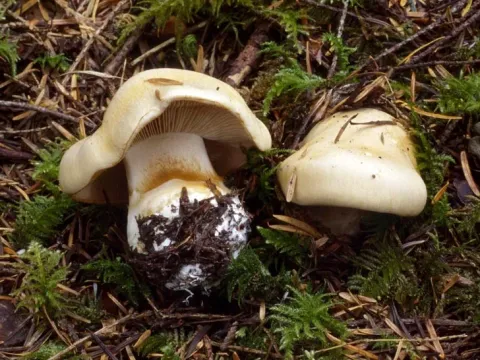
Cortinarius talus
Cortinarius talus
Cortinarius talus is not a plant pathogen and does not cause diseases in agricultural crops.
What the section contains
Cortinarius talus
It belongs to the Cortinariaceae family, consisting of fungi that generally live in symbiosis with forest trees.
This species is not listed as a pest or disease agent for any commercial crop production systems.
The fungus functions primarily as a decomposer of organic matter or as a mycorrhizal partner in forest environments.
Therefore, it requires no chemical control or intervention from an agronomic perspective.
The cap of Cortinarius talus is typically convex, exhibiting a yellowish or ochre-brown color pattern.
A distinctive feature is the web-like cortina that covers the gills in young specimens and leaves traces on the stem.
Gills are initially pale but eventually turn rusty-brown as the spores mature and deposit onto the surface.
The stem is often robust, sometimes thickened at the base, and may appear slightly fibrillose.
The overall morphology follows the typical webcap mushroom structure, though specific traits can vary by local microclimate.
This fungus thrives in deciduous or mixed forests where it can establish symbiotic relationships with hardwood species.
Optimal growth conditions involve cool, moist autumn weather, which promotes the development of sporocarps.
The soil structure must include a rich layer of leaf litter to support the extensive subterranean mycelium network.
Moderate acidity levels in the soil are generally preferred for successful development and nutrient cycling.
Wind and small forest animals play a key role in the dispersal of spores, ensuring the survival of the species.