
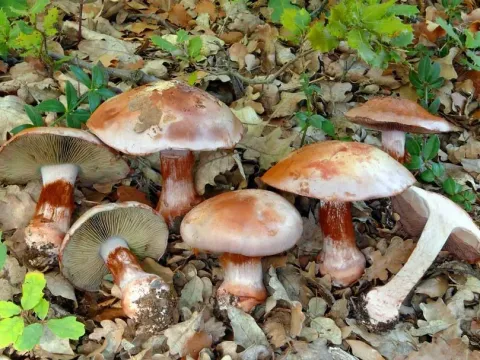
Cortinarius rufoolivaceus
Cortinarius rufoolivaceus
Cortinarius rufoolivaceus is a species of mushroom in the family Cortinariaceae. It is important to clarify that this fungus is not a plant pathogen and does not cause diseases in agricultural crops.
What the section contains
Cortinarius rufoolivaceus
This fungus is a mycorrhizal symbiont. It establishes beneficial relationships with the root systems of trees, primarily in deciduous forests, such as those dominated by oak or beech.
Biologically, it supports the host plant by enhancing water and mineral uptake from the soil, functioning as a helper organism rather than a parasite.
There is no evidence of this species invading crops or damaging plant tissues, as its ecological niche is strictly confined to forested areas with specific mycorrhizal hosts.
The fungus is characterized by its wine-red cap and olive-colored gills, which makes it a visually distinct member of the Cortinarius genus.
The primary sign of the fungus is the emergence of fruit bodies from the forest floor during late summer and autumn months.
The young cap is initially hemispherical and later expands, often becoming sticky or viscid when damp, which is a common trait for many webcaps.
A diagnostic feature is the cobweb-like veil (cortina) that protects the gills in immature specimens, eventually disappearing as the mushroom matures.
The stem is usually sturdy, often featuring a base that may have distinct colors, such as yellow or olive tones, which are helpful for field identification.
The spore print of the mushroom is rusty-brown, consistent with the general characteristics of the genus Cortinarius.
The development of Cortinarius rufoolivaceus fruit bodies is highly dependent on sufficient soil moisture and appropriate temperature regimes in the autumn.
The fungus thrives in organic-rich soils where the forest litter layer is well-developed, supporting the growth of its extensive mycelial network.
Moderate temperatures and regular rainfall are essential triggers for the formation of mushrooms, as the fungus requires stable environmental conditions.
In dry conditions, the visible growth ceases, and the fungus remains dormant as mycelium within the soil, awaiting favorable moisture levels.
The distribution of this species is tied to its host trees; thus, it is rarely found outside of established woodland or forest environments.