
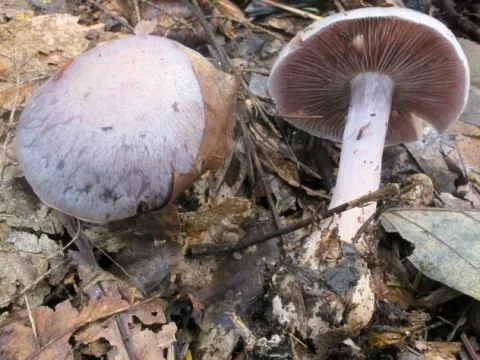
Silver Cortinarius
Cortinarius argentatus
Cortinarius argentatus, commonly known as the Silver Cortinarius, is a species of fungus in the Cortinariaceae family. It is not a plant pathogen; instead, it is a beneficial mycorrhizal fungus that forms symbiotic associations with tree roots.
What the section contains
Silver Cortinarius
This fungus establishes a connection with the host plant's root system, known as ectomycorrhiza. Through this bond, the fungus facilitates the uptake of water and essential mineral nutrients, significantly enhancing the tree's health.
Biologically, it thrives in forest environments, contributing to the decomposition of organic matter and nutrient cycling. It supports the growth of various deciduous tree species by providing essential soil resources.
The fungus is characterized by its silvery-grey appearance and the veil-like cortina that covers the gills in young specimens. These morphological traits are key to its identification in the field.
As a mycorrhizal partner, it plays a vital role in maintaining the resilience of forest ecosystems. Its presence is often considered an indicator of a well-functioning, healthy forest soil environment.
The primary indicators of its presence are the fruiting bodies found on the forest floor, typically near the root zones of trees. The cap has a distinct silvery or greyish sheen, usually 4 to 8 centimeters in diameter.
A web-like cortina covers the gills of young mushrooms, protecting them during development. As the mushroom matures, the cortina breaks, leaving faint remnants on the stem.
The stem is robust and often thickened at the base. It is typically lighter in color than the cap and may show residual traces of the veil as a ring-like zone.
As spores ripen, the gills change from a pale color to a brownish or rusty-ochre shade due to the accumulation of spore dust. This color shift is a characteristic stage in the fungal lifecycle.
Underground, the mycelium forms an extensive network of hyphae that integrate with the root tips of host trees. This network is essential for the exchange of nutrients and water between the fungus and the host.
Cortinarius argentatus requires stable soil moisture and moderate temperatures to develop its fruiting bodies. It is most active during the autumn months when conditions are cool and damp.
The fungus thrives in acidic, well-drained soils rich in organic matter. Excessive nitrogen fertilization or pesticides can adversely affect the delicate mycelial network and prevent fruiting.
A healthy forest canopy and consistent leaf litter layer provide the necessary microclimate for the fungus. It is sensitive to soil compaction and environmental pollution, which can limit its distribution.
Symbiosis is the primary requirement for the fungus. Without a compatible host tree to establish mycorrhizal connections, the fungus cannot complete its lifecycle or produce reproductive structures.
Spore dispersal relies on wind and natural disturbances. Once deposited, spores require specific temperature and moisture conditions to germinate and successfully find the roots of a suitable tree host.