
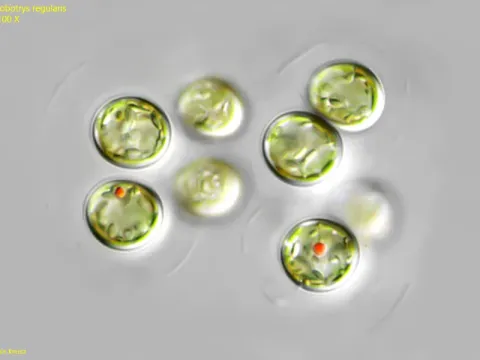
Chlorobotrys
Chlorobotrys
The causative agent of this disease is a microscopic yellow-green alga from the Chlorobotrys genus. This unicellular or colonial organism belongs to the Xanthophyta division and parasitize the surfaces of aquatic or semi-aquatic plants.
What the section contains
Chlorobotrys
Biologically, this object appears as an accumulation of cells enclosed in a mucous membrane. The pathogen actively consumes nutrients from the environment, which disrupts the physiological processes of the host plant.
The type of damage is classified as epiphytic overgrowth, which can transition into a pathogenic phase under certain conditions. Unlike fungal infections, this organism is photosynthetic, making it highly resistant to harsh environmental factors.
The organism has a high reproduction rate in aquatic environments. Its cell wall contains specific pigments that give affected areas a characteristic hue, which helps in identifying the pathogen.
Spreading occurs through motile zoospores capable of traveling long distances in water currents, ensuring rapid colonization of new areas, especially in stagnant water bodies.
The primary symptom is the appearance of a specific mucous coating on the leaves and stems of aquatic plants. The color of the coating varies from bright green to yellowish-green or olive.
As the disease progresses, the coating becomes dense and viscous, obstructing light access to plant tissues. This leads to the gradual suppression of growth and development of the affected culture.
In advanced cases, local tissue necrosis is observed under the layer of algae. Affected areas may turn brown, which indicates cell death in the epidermis due to blocked nutrition and light.
At early stages, the coating appears as small dots or a thin film. Over time, these colonies merge into large patches covering a significant portion of the leaf surface or petiole.
The presence of the pathogen can be identified by the viscous consistency of the coating, which can be easily removed mechanically, revealing the damaged tissue surface underneath.
The development of Chlorobotrys is directly dependent on an excess of nutrients, especially nitrogen and phosphorus in the water. Eutrophication of water bodies is the main trigger for the mass growth of this algae.
The optimal temperature range for active growth is between 18 and 25 degrees Celsius. An increase in water temperature significantly accelerates the life cycle of the microorganism.
High light levels promote rapid photosynthesis, allowing the pathogen to colonize the host surface faster. Direct sunlight often triggers sudden spikes in population.
Stagnant conditions in a water body facilitate the accumulation of spores near the root zone and on leaf surfaces. The lack of natural flow creates a favorable microenvironment for colony expansion.
Additionally, imbalances in water pH, exceeding the limits for a specific aquatic plant, weaken the plant's immunity and make it more susceptible to infection.
The main harm lies in the blocking of light, which stops photosynthesis. Without a normal light flux, aquatic plants quickly lose vigor and begin to yellow.
Disruption of gas exchange through stomata, caused by the mucous layer, leads to oxygen starvation of tissues. This results in the deformation of young shoots and their premature death.
Massive infestation significantly reduces the decorative value of plants, which is critical for landscaping and aquascaping. Plants lose their aesthetic appeal and market value.
The pathogen can act as a vector for secondary infections, facilitating the penetration of bacteria and fungi into the micro-cracks formed by algal activity on the plant surface.
On a larger scale, intense growth of Chlorobotrys disrupts the ecological balance of the water body, altering the chemical composition of the water and suppressing beneficial microflora.
An effective control method is regular mechanical removal of the coating from affected plant parts. Using brushes or water filtration helps reduce the pathogen population.
It is important to normalize nutrient levels in the water. Reducing the use of fertilizers that trigger eutrophication slows down the development of Chlorobotrys colonies naturally.
The use of biological algaecides is one of the safest methods for suppressing growth. These products specifically target pathogen cells without damaging higher plants.
Maintaining proper plant density allows for better water circulation and limits excessive light, creating conditions unfavorable for the pathogen's development.
- Optimization of light levels in aquarium or pond systems.
- Regular monitoring of water quality and nutrient content.
- Usage of UV sterilizers to eliminate spores in the water column.
- Prompt isolation of heavily infested specimens to prevent spread.