
Tomato chino
Chino del
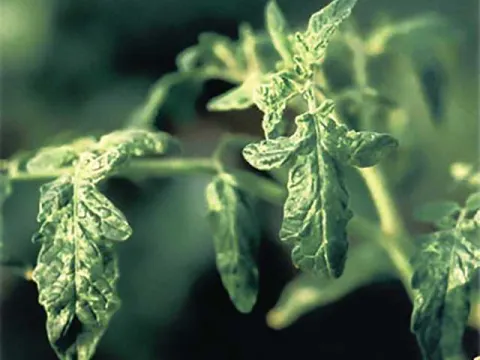
The primary symptom of this disease is pronounced leaf curling, accompanied by noticeable yellowing and a reduction in leaf size. The edges of the leaf blades often curl inward or outward, giving the plant a deformed, stunted appearance.
What the section contains
Tomato chino
Affected plants exhibit significant growth retardation compared to healthy specimens. Internodes are shortened, which leads to the formation of a compact, bushy habit and restricted overall development.
Fruit set on infected plants is extremely poor; fruits are often undersized, misshapen, or exhibit uneven coloration. In advanced cases, flowering may cease entirely, leading to total crop failure.
Upon closer inspection, necrotic spots or streaks may be observed on stems and leaf petioles. Symptom expression typically begins on the youngest leaves of the terminal growth, which are the first to show deformation.
It is important to differentiate the signs of the chino virus from symptoms of aphid damage or other mosaic virus infections. Accurate identification often requires laboratory testing of plant sap.
The causative agent of the disease is the Tomato leaf curl virus, belonging to the Geminiviridae family, specifically the genus Begomovirus. These pathogens contain single-stranded DNA.
The virus is naturally transmitted by the silverleaf whitefly (Bemisia tabaci). The insect acquires the virus by feeding on the sap of an infected plant, subsequently becoming capable of transmitting it to healthy crops.
Viral particles are highly contagious and persist within the vector for its entire lifespan. The efficiency of virus transmission increases with the duration of whitefly feeding on the host plant.
In addition to tomatoes, this pathogen widely affects pepper plants, where it causes similar symptoms of leaf deformation and chlorosis. The virus can also survive in various weed species within the Solanaceae family.
Unlike many bacterial or fungal diseases, the chino virus cannot be cured with chemical treatments once it has successfully entered the vascular system of the host plant.
The development of epidemics is directly dependent on the population density of whiteflies in the region. The peak activity of the insect vector occurs during periods of high air temperature and low humidity.
Arid seasons promote faster movement of whiteflies between fields. Water stress weakens the immunity of vegetable crops, making them more susceptible to heavy viral loads.
Favorable conditions for spreading are created when there is a wide range of wild reservoir plants that serve as an inoculum source at the beginning of the growing season.
Failure to follow crop rotation practices, such as planting Solanaceae crops in the same field for several consecutive years, contributes to the accumulation of the virus in the soil and the local ecosystem.
Insufficient weed control on field margins and adjacent areas creates an ideal environment for the overwintering and reproduction of virus vectors during the off-season.
The chino virus poses a massive threat to industrial tomato and pepper cultivation. Infection during the early growth phase can lead to a complete loss of productivity for individual plants.
Economic losses arise from a significant reduction in the marketability of the produce, which becomes unsuitable for sale. Fruits lose both their culinary quality and weight.
Infected areas can become a source of infection for all neighboring farms. The speed of viral spread in a population, without vector control, can reach critical levels rapidly.
The lack of breeding resistance in many popular commercial varieties makes the problem of managing this disease a high priority for agronomists and breeders worldwide.
Costs associated with chemical field treatments to combat whiteflies significantly increase production expenses, making disease management financially burdensome for small and medium-sized farms.
The primary control measure is strict management of the whitefly population. The use of systemic insecticides helps reduce the number of virus vectors within the plantations.
Regular removal and destruction of all infected plants, including the root system, is necessary. This helps lower the infectious pressure within the field.
Utilizing insect-proof screens to prevent the entry of whiteflies into greenhouses is one of the most effective methods for preventing infection in protected cropping environments.
Adhering to strict quarantine measures when sourcing seedlings from other regions is critical. Seedlings should be grown in isolated conditions that preclude contact with whiteflies.
- Clearing fields of reservoir weeds.
- Using yellow sticky traps for monitoring whitefly populations.
- Selecting virus-resistant varieties and hybrids.
- Timely application of insecticides on field perimeters.