
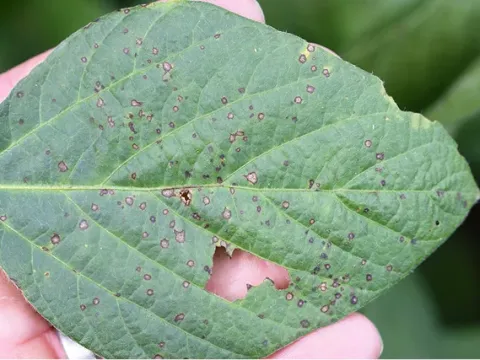
Cercospora leaf blight of soybean
Cercospora sojina
The causal agent of Cercospora leaf blight is the fungus Cercospora sojina, classified within the Hyphomycetes group. This pathogen survives on crop residues, in the soil, and is frequently transmitted through infected seeds.
What the section contains
Cercospora leaf blight of soybean
The fungus produces conidia, which are efficiently dispersed by wind and splashing rain onto healthy soybean plants. This dispersal cycle allows the pathogen to spread across entire fields rapidly under suitable environmental conditions.
Infection typically occurs when spores penetrate the leaf tissue through stomata or directly through the cuticle. Once inside, the fungal mycelium colonizes the inter-cellular spaces, leading to the development of necrotic lesions.
The pathogen's persistence in soil is largely dependent on the rate of crop residue decomposition. Infected seeds remain a critical primary inoculum source for subsequent growing seasons.
While the pathogen exhibits host specificity towards the Fabaceae family, the strains affecting Glycine max are particularly aggressive and adapted to soybean cropping systems.
The most distinctive symptom is the appearance of leaf spots commonly referred to as "frog-eye" leaf spots. These spots are characterized by a dark brown center surrounded by a lighter, greyish-white or tan-colored margin.
As the disease progresses, lesions may expand and coalesce, leading to large necrotic areas on the leaves. Under high humidity, a grey to olive-colored velvety layer appears on the underside of the leaves, indicating active sporulation.
Infections can also manifest on stems, petioles, and pods. Stem lesions often appear as elongated, dark brown streaks, which may reduce the structural integrity of the plant as it matures.
Seeds from severely infected plants may show greyish discolouration or irregular spots and are often shriveled. In some cases, a distinct purple discoloration of the seed coat can be observed.
Premature leaf drop is a common late-stage symptom. This severe defoliation significantly impairs photosynthesis, resulting in stunted plant development and reduced grain fill.
Favorable environmental conditions for Cercospora sojina include warm temperatures, typically ranging from 20 to 28 degrees Celsius. The presence of surface moisture is a strict requirement for spore germination.
Frequent rainfall, heavy dew, and high atmospheric humidity are the primary drivers of disease outbreaks. Prolonged periods of leaf wetness significantly increase the infection rate within the canopy.
High planting density contributes to disease severity by creating a microclimate with restricted airflow, which keeps the lower canopy moist for longer periods compared to thinner stands.
Crop rotation is essential, as continuous soybean cultivation in the same field leads to an accumulation of inoculum in the soil, significantly increasing the probability of early-season infection.
The presence of weeds serves as an alternative host and a factor that increases canopy humidity, thereby facilitating the rapid spread of the disease across the field.
The economic impact of the disease is largely driven by the reduction in leaf area index, which directly limits the plant's capacity for photosynthesis and nutrient assimilation, causing substantial yield loss.
Seed damage results in lower grain quality, reduced test weights, and compromised protein and oil content, making the harvested product less desirable for processing and market trade.
In cases of early-season onset, the disease can reduce plant vigor and lead to stand loss, which may necessitate replanting or result in thin, unproductive crop stands.
Infected seeds often have poor germination and reduced seedling vigor. This can lead to uneven crop emergence, complicating subsequent agronomic management and pest control efforts.
Under heavy infection pressure, yield losses can range from 20% up to 30%, especially in seasons where weather conditions consistently favor fungal development throughout the reproductive stages.
The most effective strategy for managing Cercospora leaf blight is the deployment of resistant or tolerant soybean cultivars. This serves as the foundation for integrated disease management programs.
Seed treatment with systemic fungicides is crucial to eliminate surface-borne inoculum and protect young seedlings during the initial establishment phase of the crop.
Effective agronomic practices, such as tillage that buries crop residues, help to speed up the decomposition of infected tissues and significantly reduce the primary inoculum load in the field.
Fungicide applications during the reproductive stages (R3 to R5) are recommended if the disease pressure is high. Combinations of strobilurins and triazoles are often used to manage the fungus effectively.
Integrated weed management and strict adherence to a 3-4 year crop rotation cycle are vital for minimizing the long-term impact of the pathogen on soybean productivity.