
Cercospora leaf spot of African violet
Cercospora peckiana
Description
Symptoms
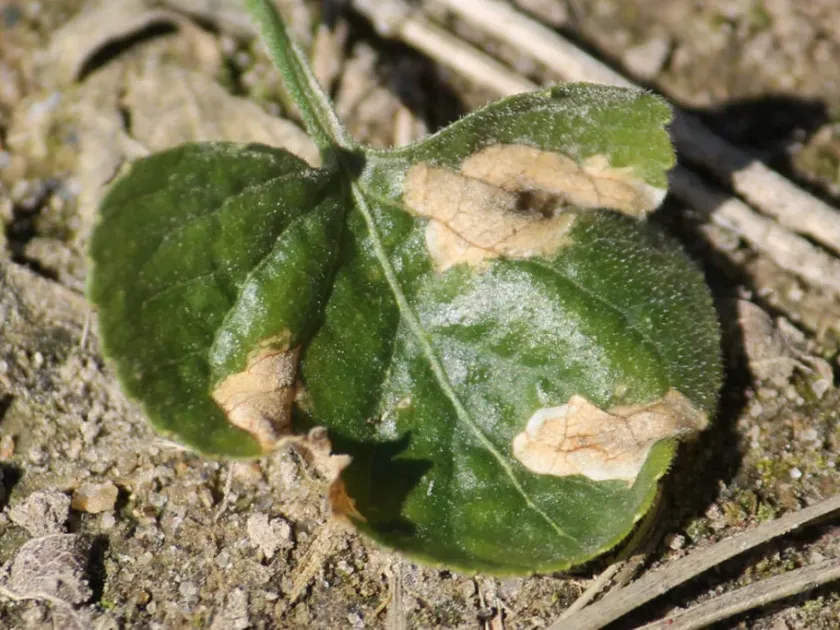
Initial symptoms of Cercospora infection present as small, chlorotic spots on the leaf surface. As the infection progresses, these spots expand and turn brown or reddish-brown, often surrounded by a darker border.
A distinctive feature of this disease is the development of a grayish-olive velvety mold on the underside of the leaves. This represents the fungal sporulation occurring directly on the necrotic tissue.
Over time, the affected areas become brittle and may drop out, leaving holes in the leaves. Severe infection leads to widespread yellowing (chlorosis) and premature leaf fall.
The disease can also manifest on petioles and flower stalks, causing the stems to weaken or collapse. The aesthetic impact is significant, as the symmetrical rosette of the African violet becomes disfigured.
Differentiating this from other leaf spots is essential, and the presence of the characteristic mold on the underside of the leaf is the most reliable clinical sign for identification.
Pathogen
The disease is caused by the fungus Cercospora peckiana, a pathogen known for its ability to infect various ornamental plants. It belongs to the group of deuteromycetes, which reproduce through asexual spores known as conidia.
These conidia are small and lightweight, allowing them to disperse easily via air currents, water splashes, or even through tools used in gardening. The fungus invades the leaf tissue, establishing itself in the interstitial spaces.
Once inside, the fungus secretes enzymes that degrade cellular structures, leading to necrosis. It is a persistent pathogen that can thrive in various environments if the moisture levels are sufficient.
The fungal mycelium can remain viable in plant debris for extended periods, serving as a primary source of inoculum for subsequent infection cycles within a collection.
Understanding the biology of Cercospora peckiana is crucial, as the fungus relies on the host's vitality; however, it can quickly overcome the defenses of even healthy plants under favorable conditions.
Conditions for development
High relative humidity, typically exceeding 70%, is the primary environmental factor that drives the development and spread of Cercospora peckiana.
Temperatures between 20°C and 25°C create an optimal environment for the fungus to complete its reproductive cycle. In these temperatures, the rate of infection can increase exponentially.
Poor air circulation, common in crowded indoor plant displays or greenhouses, prevents the foliage from drying after watering, creating a stagnant microclimate favorable for fungal growth.
Extended periods of leaf wetness are critical for spore germination. Frequent overhead watering or misting significantly exacerbates the risk of an outbreak.
Environmental stress, such as improper lighting or nutrient imbalances, lowers the plant's resistance, making it more susceptible to penetration by the fungal hyphae.
Why it matters
The main harm inflicted by the pathogen is the disruption of photosynthesis due to the loss of functional leaf area. This significantly limits the energy production required for healthy growth.
Because African violets are primarily grown for their foliage and flowering potential, the disfigurement caused by Cercospora renders the plant unusable for display or propagation.
The rapid spread of the fungus within a collection poses a systemic threat. Without immediate intervention, an entire collection can be severely compromised in a relatively short period.
The weakening of the plant's structural integrity makes it highly prone to secondary bacterial infections, which can progress rapidly and lead to the eventual collapse of the entire rosette.
Recovering from the disease is a slow process, often requiring the complete removal of infected leaves and extensive treatment, which may still result in a permanently weakened plant.
Protection
The first line of defense is strict sanitation. All infected leaves should be removed immediately, placed in sealed bags, and disposed of to prevent the spread of spores.
Improving the environment is paramount; ensure good airflow and switch to sub-irrigation (bottom watering) to keep the foliage dry at all times.
Chemical control involves the application of appropriate fungicides. Products containing copper or specific systemic fungicides (like those from the triazole group) are generally effective against Cercospora species.
- Isolate all symptomatic plants immediately.
- Disinfect all tools, trays, and surfaces regularly.
- Increase spacing between plants to maximize air circulation.
- Apply systemic fungicides according to the manufacturer’s instructions.
Long-term prevention requires a rigorous quarantine procedure for all new plant arrivals and the maintenance of a consistent, well-ventilated growing environment.
Discussion
No discussions yet — be the first.