
Cercospora leaf blight
Cercospora kikuchii
Description
Symptoms
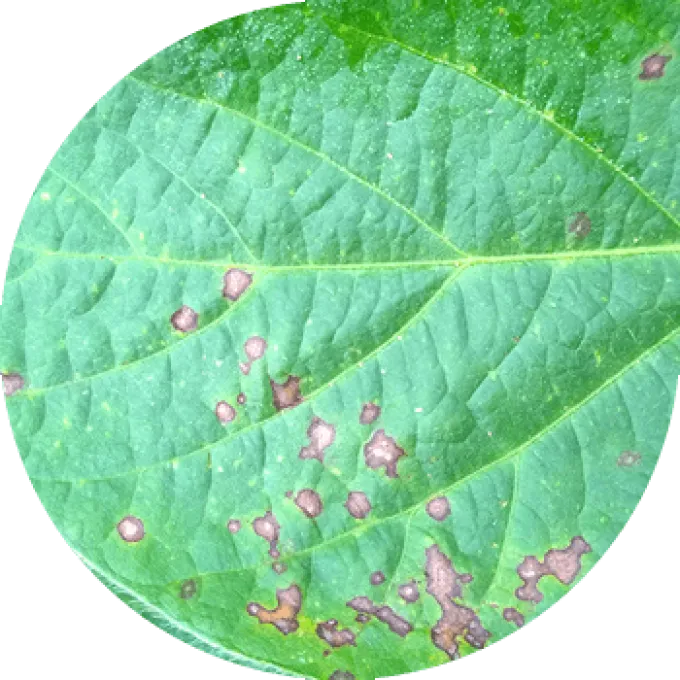
In early stages, symptoms appear on the leaves as small purple or reddish-brown spots. Over time, these spots can coalesce into larger necrotic areas, often surrounded by chlorotic tissue, eventually leading to premature leaf drop.
The most distinctive symptom is observed on the seeds, which develop an intense purple or dark violet stain. This discoloration can range from small, irregular spots to the complete coverage of the seed surface, significantly degrading its market quality.
Stems and petioles of infected plants also show dark, elongated lesions. In conditions of high humidity, a grayish-olive mycelial growth may be visible on the surface of the lesions, indicating the active sporulation of the fungus.
When pods are infected during the filling stage, they may become distorted and result in shriveled, underdeveloped seeds. The plant itself often shows stunted growth and signs of general chlorosis as the infection progresses.
Visual identification in the field can be challenging, as the purple pigmentation can sometimes be confused with natural physiological maturity; however, the presence of these lesions on vegetative parts is a reliable diagnostic indicator for Cercospora kikuchii.
Pathogen
The causal agent of purple seed stain and leaf blight is the fungus Cercospora kikuchii. This pathogen belongs to the class of hyphomycetes and can persist for long periods in the soil, on crop residues, and within infected soybean seeds.
The life cycle involves the formation of conidia, which are disseminated by wind, rain splashes, or insect vectors. During the growing season, the pathogen can produce multiple generations of spores, facilitating the rapid spread of the infection throughout the field.
The fungus is host-specific, primarily affecting the family Fabaceae, with soybean being the main economic host. In agricultural science, this pathogen is often studied alongside other soybean diseases because it is efficiently transmitted through seed, serving as a primary inoculum source.
The pathogenicity of the fungus relies on the secretion of a specific toxin called cercosporin. This compound is activated by sunlight and causes the disruption of cellular membranes, which leads to the characteristic purple discoloration of the affected plant tissues.
The mycelium of the fungus penetrates deep into the seed tissues, affecting both the seed coat and the embryo. This makes the disease particularly difficult to manage, as standard seed treatments may not always ensure the total elimination of the pathogen from deeper layers.
Conditions for development
The development of the disease is highly favored by warm, humid weather with frequent rainfall during the flowering and pod-filling stages. The optimal temperature range for the pathogen's growth is between 25 and 30 degrees Celsius.
Prolonged periods of high relative humidity, typically exceeding 80%, are critical factors that trigger the germination of conidia and mass dispersal of spores within the soybean canopy.
Poor agricultural practices, such as high planting density, create a dense microclimate within the crop canopy with limited air circulation, which maintains moisture and accelerates the spread of the infection.
The presence of significant amounts of soybean crop residues on the soil surface after harvest acts as the primary reservoir for the fungus, allowing it to survive until the next planting season.
Environmental stress, such as drought or nutrient deficiencies, compromises the plant's natural immune response, making the crop significantly more susceptible to colonization by the fungus during vulnerable developmental stages.
Why it matters
The primary economic damage results from a substantial decrease in seed quality, as stained seeds lose their market value and often fail to meet the strict standards required for processing and export markets.
The disease reduces seed germination rates and seedling vigor, which leads to poor stand establishment when infected seeds are used for planting in subsequent seasons.
Damage to the leaf canopy reduces the photosynthetic area, which directly leads to lower thousand-kernel weight and a reduction in the total yield per hectare.
The disruption of physiological ripening leads to shriveled seeds with reduced oil and protein content, which significantly lowers their value as a raw material for livestock feed or industrial applications.
Severe infestations can lead to massive defoliation and early plant death, which complicates mechanical harvesting and leads to substantial losses of the potential crop.
Protection
Effective management begins with the use of certified, disease-free seed that has undergone phytosanitary inspection, complemented by high-quality systemic fungicide seed treatments.
Crop rotation is an essential preventive measure; rotating soybeans with non-host crops for at least 2–3 years helps to reduce the inoculum level by allowing the fungus to naturally decompose in crop residues.
Deep tillage is an important cultural practice that buries infected crop residues, effectively removing them from the soil surface and interrupting the life cycle of the pathogen.
The application of foliar fungicides during the growing season, particularly during the flowering and early pod-filling phases, can significantly limit disease spread when weather conditions favor outbreaks.
The use of resistant or tolerant soybean varieties is highly recommended, as genetic resistance provides a foundational strategy to limit the colonization and progression of Cercospora kikuchii even under high disease pressure.
Discussion
No discussions yet — be the first.