
Cercospora leaf spot
Cercospora beticola
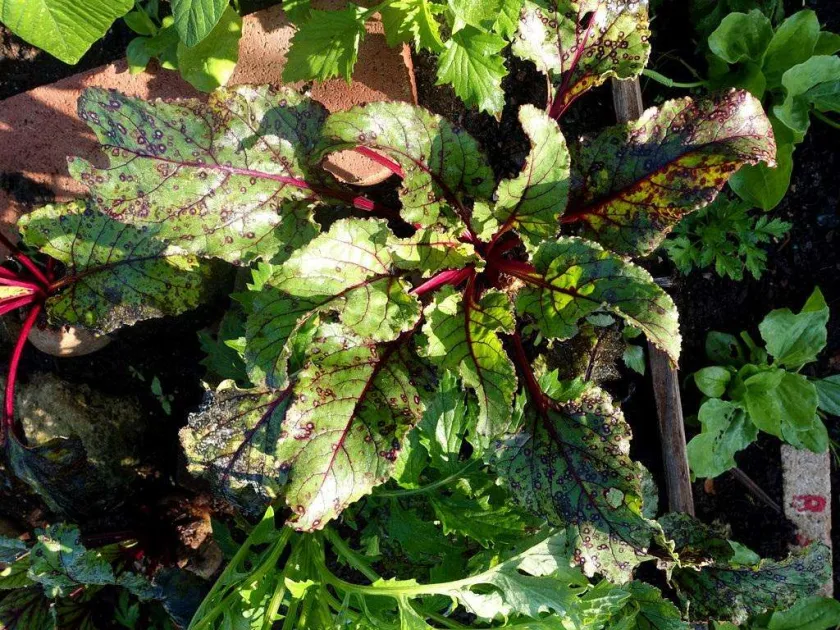
Description
Symptoms
The primary symptom is the appearance of small, circular spots on the leaves, typically measuring 2–5 mm in diameter.
These lesions feature a characteristic light tan or gray center surrounded by a distinct dark red or purplish-brown border.
Under high humidity, a fuzzy, grayish-white appearance develops in the center of these spots, which represents the sporulation of the fungus.
As the infection progresses, lesions become numerous and coalesce, eventually causing the entire leaf to wither and turn necrotic.
Lower leaves are usually affected first, leading to a "firing" appearance where the oldest leaves die prematurely, forcing the plant to produce new foliage.
Pathogen
The causal agent of Cercospora leaf spot is the fungus Cercospora beticola, which is a significant pathogen of Beta vulgaris species.
This fungus survives between growing seasons as dormant mycelium in crop residues left on the soil surface or within infected seeds.
Cercospora beticola is classified as a hemibiotrophic pathogen, meaning it initially colonizes living tissues and then kills them to complete its lifecycle.
During the favorable season, the fungus produces conidia on conidiophores, which emerge through the stomata of the host leaves.
Dissemination occurs primarily via splashing rain, wind gusts, and contact with agricultural machinery, leading to rapid disease spread within a field.
Conditions for development
Cercospora leaf spot thrives in warm weather with daytime temperatures between 25°C and 30°C accompanied by high humidity.
Extended periods of leaf wetness, such as prolonged dew or frequent rainfall, are essential for the germination of fungal spores.
The microclimate created by dense canopy closure in sugar beet fields significantly increases humidity, favoring the development of the disease.
Stress factors, such as nitrogen deficiency or lack of soil moisture, can make the crop more susceptible to the colonization of this pathogen.
The disease usually becomes most severe in mid-to-late summer when the environmental conditions coincide with the maximum leaf area development.
Why it matters
The economic impact of this disease is severe, as it causes massive defoliation and forces the plant to tap into its root energy reserves.
This redirection of resources leads to a significant decrease in root yield and, more importantly, a substantial reduction in sucrose concentration.
Reduced sucrose levels negatively affect the processing quality of the beet, resulting in lower sugar extraction efficiency at refining plants.
Because of the reduced sugar content and impaired respiration, roots stored in clamps exhibit higher rates of decay and further sugar loss.
If left untreated, Cercospora leaf spot can easily result in overall crop yield losses exceeding 50% in highly susceptible varieties.
Protection
Cultural management is the first line of defense, specifically emphasizing a crop rotation period of at least three years away from host crops.
Deep plowing to bury infected leaf debris is highly effective in reducing the initial inoculum load in the field for the following season.
The selection and cultivation of resistant or tolerant sugar beet varieties serve as a core component of integrated pest management programs.
Chemical control involving fungicides with different modes of action is necessary to prevent the development of resistant fungal populations.
- Crop rotation (3+ years).
- Deep burial of crop residues.
- Use of resistant hybrid varieties.
- Timely fungicide applications (triazoles, strobilurins).
Discussion
No discussions yet — be the first.