
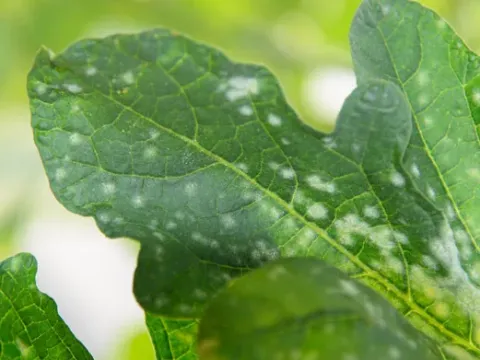
Powdery mildew of cassava
Oidium manihotis
The causal agent of this disease is the fungus Oidium manihotis, which is an obligate biotrophic pathogen. It requires living plant tissue to thrive and complete its lifecycle, drawing essential nutrients from the host.
What the section contains
Powdery mildew of cassava
Belonging to the powdery mildew group, this fungus produces abundant conidia that are easily dispersed by wind. This biological feature allows the disease to spread rapidly across large cassava fields in relatively short periods.
The fungus develops a superficial white mycelial network on the leaves, which serves as the site for spore production. This mycelium effectively covers the leaf surface, interfering with light absorption and gas exchange.
It utilizes haustoria to penetrate the plant's epidermis, extracting nutrients directly from individual plant cells without initially killing the host. This mechanism allows the parasite to sustain itself for prolonged periods.
Oidium manihotis is well-adapted to the environmental conditions of tropical cassava-growing regions. It demonstrates a high capacity to survive in varying humidity levels while maintaining its reproductive potential.
The primary symptom is the appearance of characteristic white or grayish powdery patches on the upper surface of cassava leaves. Over time, these patches can cover the entire leaf, including the petiole and young stems.
As the infection progresses, affected leaves may show symptoms of chlorosis, leading to yellowing and premature shedding. The leaves often curl, twist, or become deformed due to the fungal growth.
The white powdery substance is essentially a collection of fungal hyphae and spores. While it can be easily wiped away, the underlying leaf tissue often shows necrotic spots or localized tissue collapse.
Younger, more actively growing leaves are typically more susceptible to attack. Severe infestations can cause the entire canopy of the plant to look grayish and wilted, signaling a significant disease outbreak.
In addition to leaf symptoms, the pathogen may cause stunting of the entire plant, leading to a reduced number of leaves and smaller plant architecture compared to healthy specimens.
Oidium manihotis thrives best in warm, relatively dry environmental conditions. Unlike many other fungal pathogens, it does not require free water or prolonged leaf wetness to initiate infection.
High humidity levels within the crop canopy, caused by poor air circulation or overcrowding, are major factors that promote the development of the disease. Stagnant air allows spores to settle and germinate more effectively.
Fluctuating temperatures between day and night significantly enhance the spore production of the fungus. Such conditions often trigger sudden and rapid disease spread across the field.
Plants subjected to poor nutrient management, particularly those receiving excess nitrogen and insufficient potassium, are significantly more susceptible to infection. Optimal plant health is a natural barrier to the disease.
The presence of susceptible weed species within or near the field can serve as a reservoir for the pathogen. Clean cultivation practices are essential to break the infection cycle in the field environment.
The economic impact of the disease is primarily due to the severe reduction in photosynthetic capacity caused by leaf loss and fungal covering. This directly limits the accumulation of starch in the storage roots.
As leaves drop prematurely, the cassava plant loses its energy-producing organs, leading to thinner, smaller roots with lower starch content. This represents a direct yield loss for farmers.
Persistent infection weakens the overall health of the cassava crop, making it more susceptible to environmental stress and secondary pathogen attacks. This undermines the long-term productivity of the plantation.
In cases of severe epidemics, the cumulative loss can significantly impact the quality of the harvest. Tubers produced from diseased plants are often of lower commercial and nutritional value.
The loss of foliage can also expose the soil beneath the plants to increased heat and erosion, further degrading the field environment over the course of the growing season.
The most effective strategy for managing cassava powdery mildew is the planting of resistant or tolerant cultivars. Breeding programs focus on identifying genetic sources of resistance to this specific pathogen.
Good agricultural practices, such as maintaining proper plant spacing, are crucial to ensure adequate air movement within the field, thereby reducing the humidity favorable for fungal development.
Sanitation is key; the removal and destruction of infected plant debris help reduce the amount of primary inoculum for the next growing season. This limits the initial spread of the fungus.
Chemical control can be implemented using sulfur-based fungicides, which are traditionally effective against powdery mildew. Application should be timed correctly to prevent leaf burn and maximize effectiveness.
- Use of disease-free planting material to prevent initial introduction.
- Implementation of regular field monitoring for early symptom detection.
- Balanced application of fertilizers to improve host plant resistance.
- Strategic crop rotation to reduce soil-borne pathogen load and reservoirs.