
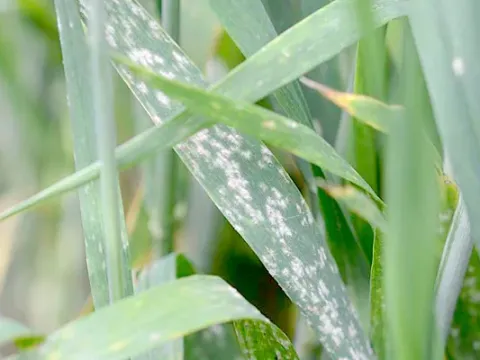
Powdery mildew of cereals
Blumeria
The causal agent of powdery mildew is the obligate biotroph fungus Blumeria graminis. This pathogen is highly host-specific, with various forms (formae speciales) attacking wheat, barley, rye, and oats.
What the section contains
Powdery mildew of cereals
The fungus exists primarily as an external mycelium on the surface of host tissues. It forms specialized feeding structures called haustoria, which penetrate the epidermal cells to extract nutrients from the plant.
The life cycle involves the production of masses of asexual spores called conidia, which are easily disseminated by wind. Under favorable conditions, these spores allow for rapid secondary infections across the field.
The fungus overwinters either as dormant mycelium on winter cereal crops or as cleistothecia (small, dark, spherical fruiting bodies) on crop residues. These structures are resistant to environmental stressors.
Due to its rapid reproductive cycle, Blumeria graminis can quickly build up large populations, making it a persistent challenge for cereal production in humid and temperate regions.
The most distinctive symptom is the appearance of white, fuzzy, cotton-like patches on leaves, stems, and leaf sheaths. These patches represent the fungal mycelium and conidiophores.
As the infection matures, these patches often turn greyish or light brown. Small black dots, which are the cleistothecia, may eventually appear within the old mycelial mat.
Infected leaves often develop chlorosis (yellowing) and may eventually wither and die prematurely. In severe cases, the entire plant can become stunted and deformed.
The disease typically starts at the base of the plant where the humidity is higher and the air movement is lower, gradually moving upwards as the season progresses.
In addition to leaf damage, severe infections on the ear (head) can lead to partially sterile spikes and grain shriveling, significantly impacting the overall yield quality.
Powdery mildew thrives in moderate temperature ranges, typically between 15°C and 22°C. These temperatures allow the fungus to complete its life cycle in just a few days.
High relative humidity, particularly between 60% and 90%, is highly conducive to spore germination and colonization. Unlike many other fungal diseases, liquid water is not strictly required for infection.
Dense crop stands create a stable microclimate with limited airflow, which promotes the development of the fungus. Shaded conditions within the canopy also reduce the plant's natural defense responses.
Excessive nitrogen fertilization leads to rapid, lush vegetative growth that is structurally softer and more susceptible to fungal penetration, increasing the risk of severe disease outbreaks.
Fluctuating temperatures and heavy morning mists are often associated with periods of rapid disease spread, providing the necessary moisture and temperature balance for the pathogen.
The primary impact of powdery mildew is the reduction of the leaf surface area available for photosynthesis. This depletion of energy resources directly limits the plant's ability to fill the grain.
By causing premature senescence of the flag leaf, the fungus significantly reduces the grain-filling period, which is the most critical phase for yield determination in cereals.
Heavily infected plants are often more prone to secondary stress factors, including drought and lodging. The weakened tissues are also more vulnerable to opportunistic pathogens.
The economic impact can be severe, with yield losses ranging from 10% to 30% depending on the infection timing and environmental conditions during the grain-filling stage.
Quality parameters are also adversely affected; infected crops often yield grain with lower protein content, reduced starch accumulation, and lower test weights.
The primary defense strategy is the deployment of resistant or tolerant cereal cultivars. Breeding programs focus on introducing resistance genes to mitigate the impact of Blumeria graminis.
Good agronomic practices, such as balanced fertilization and proper seeding rates, help maintain crop vigor and reduce the humidity within the canopy, making the environment less hospitable to the fungus.
Cultural control measures include the removal of volunteer plants (cereal re-growth) and crop residues, which act as "green bridges" for the pathogen to survive between seasons.
Fungicide application is necessary when the disease reaches economic threshold levels. Effective chemical classes include triazoles, strobilurins, and morpholines, often applied during stem elongation.
Integrated Pest Management (IPM) encourages regular scouting and the use of preventative seed treatments to protect young seedlings from early-season infections.