
Powdery mildew of cereals
Blumeria graminis
Description
Symptoms
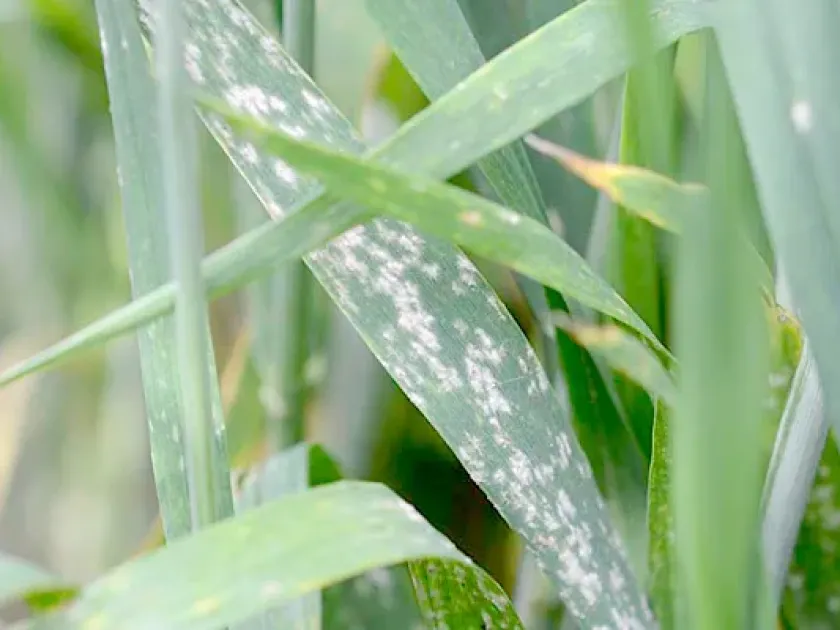
Initial symptoms appear as white, web-like mycelial patches on lower leaves, leaf sheaths, and stems. Over time, these patches become denser, taking on a powdery appearance and a greyish-white color, resembling a light dusting of flour.
As the infection matures, small black dots known as cleistothecia develop within the fungal mats. These structures mark the transition to the sexual stage of the pathogen's life cycle and indicate that the disease is well-established.
Heavily infected leaves turn yellow, lose their vitality, and eventually die prematurely. This loss of functional leaf area significantly impacts the plant's overall growth and development, particularly during the critical stages of tillering and stem elongation.
Under favorable conditions, the infection spreads to the upper leaves and ears. This can cause shriveled grain, reduced kernel weight, and structural damage to the plant, which may lead to lodging and lower harvest quality.
Visual identification is usually straightforward in the early stages, though rain may wash off the powdery mycelium, leaving behind characteristic chlorotic spots that indicate where the fungus was previously active.
Pathogen
The causal agent of this disease is an obligate parasite, the fungus Blumeria graminis. It belongs to the Erysiphaceae family and exhibits a high degree of host specificity, meaning specific fungal forms (formae speciales) target distinct cereal species like wheat or barley.
The life cycle involves both asexual reproduction via wind-dispersed conidia and sexual reproduction through the formation of cleistothecia. Cleistothecia are dark, fruit-like structures that allow the fungus to survive the winter on crop residues and stubble.
The pathogen thrives on the plant surface, forming a dense white mycelium. It uses specialized structures called haustoria to penetrate epidermal cells, extracting nutrients and causing the host tissue to weaken and eventually wither.
This disease affects a wide range of cereals, including winter and spring wheat, barley, rye, and oats. Many wild grass species also act as reservoir hosts, facilitating the spread of spores to cultivated fields throughout the growing season.
Blumeria graminis produces numerous generations of spores within a single growing season, allowing for rapid disease development. The rapid dissemination of conidia by wind makes it a significant risk in high-density cereal production systems.
Conditions for development
The pathogen thrives in moderate temperatures ranging from 15 to 22 degrees Celsius. While it is adaptable, extreme heat above 25 degrees Celsius tends to inhibit its growth and slow down the production of new conidia.
High relative humidity, typically between 60 and 95 percent, is essential for optimal spore germination and colonization. Misty conditions, dew, and frequent light rain are primary drivers of powdery mildew outbreaks in agricultural fields.
Excessive nitrogen fertilization is a major risk factor, as it encourages lush, vegetative growth with high sugar content in the leaves. This nutrient-rich environment is ideal for the rapid colonization and spread of the fungus.
Dense crop stands create a microclimate with restricted airflow, trapping humidity within the canopy. This environment is highly conducive to the disease, allowing the fungus to spread rapidly from plant to plant throughout the field.
The presence of volunteer plants (cereal re-growth from the previous harvest) often serves as a "bridge" for the infection, allowing the fungus to survive and thrive before moving into the newly planted crop.
Why it matters
The primary damage caused by powdery mildew is the reduction of the photosynthetic leaf area. By destroying chloroplasts and consuming plant nutrients, the fungus severely limits the plant's ability to produce energy for grain development.
Reduced tillering and stunted growth are common outcomes of early infections. These factors decrease the overall plant density and the number of productive ears per unit area, directly impacting the final yield potential.
The quality of the grain is also compromised, as the fungus affects the nutrient supply to the developing kernels. This often results in lower bushel weight, reduced protein content, and poor overall grain quality for the market.
Weakened plants are more susceptible to secondary infections and physiological stresses such as drought. The cumulative effect of these stresses can lead to premature senescence and significant economic losses for farmers.
The cost of implementing chemical control measures, combined with the potential yield loss, makes powdery mildew a significant economic threat that requires constant vigilance and effective management strategies.
Protection
The most effective strategy is the use of resistant or tolerant cereal cultivars. Breeding programs focus on developing varieties that possess specific resistance genes, providing a cost-effective way to mitigate disease impact.
Cultural practices, such as crop rotation, avoiding over-application of nitrogen fertilizers, and ensuring proper field sanitation, help limit initial infection. Destroying volunteer plants is also a critical step in breaking the disease cycle.
Monitoring the crop for signs of the disease is crucial for timely intervention. If the economic threshold is met, the application of systemic fungicides, such as triazoles or strobilurins, is highly effective in stopping the spread of the fungus.
Balanced fertilization, particularly with potassium and phosphorus, improves the strength of the plant's cell walls, making them more resistant to fungal penetration. This helps the crop maintain its natural defenses against pathogen attack.
Adopting an Integrated Pest Management (IPM) approach, which combines resistant varieties, proper agronomic practices, and targeted fungicide applications, ensures long-term control while minimizing the risk of developing fungicide resistance.
Discussion
No discussions yet — be the first.