
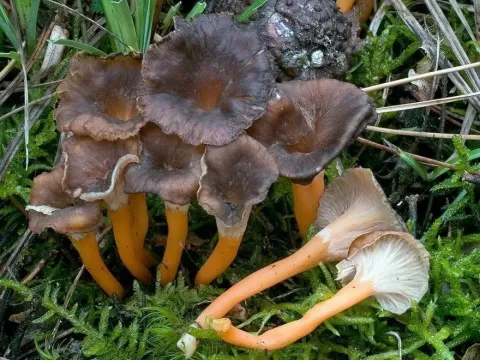
Yellow chanterelle
Cantharellus aurora
The yellow chanterelle (Cantharellus aurora) is distinguished by its small, funnel-shaped cap that often displays a wavy or irregular margin.
What the section contains
Yellow chanterelle
The coloration of the cap ranges from dull yellow to brownish-orange, while the underside features shallow, vein-like folds instead of true gills.
Its stem is typically hollow, slender, and yellow, often appearing slightly translucent compared to other species of the Cantharellus genus.
These fungi grow in dense clusters, frequently nestled within mossy surfaces in moist, coniferous forest environments.
These visible growth patterns are purely ecological and should not be mistaken for symptoms of a plant disease or fungal infection of crops.
The organism Cantharellus aurora is a basidiomycete fungus and is absolutely not a pathogen to agricultural or horticultural crops.
It operates as a mycorrhizal species, living in a mutualistic relationship with the roots of trees, providing them with water and minerals in exchange for sugars.
Unlike parasitic fungi that degrade host tissues, this species does not cause structural damage, lesions, or necrosis to any plant material.
The life cycle involves spore production on the hymenium (the folds beneath the cap) and the development of a subterranean mycelial network.
As a non-pathogenic organism, it is entirely outside the scope of plant pathology, posing no threat to the vitality of vegetation.
This fungus requires high moisture levels and specific symbiotic hosts, such as spruce or pine trees, to successfully form its fruiting bodies.
It thrives in soils with an acidic pH and a thick layer of organic forest litter, which provides the necessary nutrients for its mycelium.
Temperature fluctuations, particularly the cool, humid conditions of late summer and autumn, are essential for stimulating its growth cycle.
It is sensitive to environmental degradation, such as excessive fertilization or soil compaction, which often leads to its disappearance from a site.
The species prefers undisturbed woodland settings, making it an unlikely visitor to manicured gardens or intensive agricultural fields.
There is zero harm associated with Cantharellus aurora concerning plant health, as it is a beneficial part of the forest ecosystem.
It does not deplete nutrients from crops, nor does it secrete toxins that inhibit the development of nearby garden or field plants.
Since it is not a plant disease, it causes no loss in agricultural productivity, yield quality, or ornamental value of plants.
In fact, the presence of mycorrhizal fungi generally enhances the stress tolerance and nutrient uptake capacity of its tree hosts.
Misclassification of this species as a disease agent is scientifically incorrect and potentially misleading for amateur gardeners or farmers.
No protection or control measures are required for Cantharellus aurora, as it is a non-threatening, wild forest fungus.
Using fungicides to eliminate this species would be ecologically harmful and unnecessary, as it provides no pathogenic threat to plants.
If its growth is unwanted in a specific landscape area, cultural practices like improving drainage or increasing soil aeration are sufficient to naturally discourage it.
There is no phytosanitary regulation or alert regarding this fungus, confirming its status as a non-pest organism in global agriculture.
Management efforts are completely unnecessary; it is recommended to enjoy its presence as an indicator of a healthy, functioning forest ecosystem.