
Yellow Sigatoka
Pseudocercospora musae
Description
Symptoms
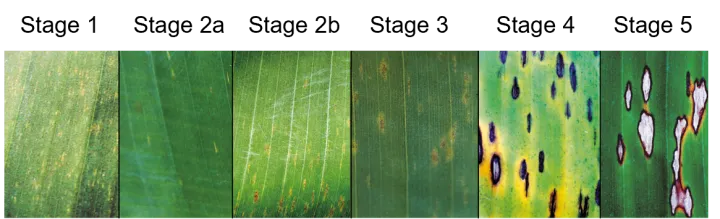
The earliest symptoms appear as small, chlorotic, yellow or green streaks or spots that align with the leaf's secondary veins.
As the infection progresses, these spots expand, turn brown or rusty-red, and develop into characteristic elliptical lesions.
A hallmark of Yellow Sigatoka is the presence of a bright yellow halo surrounding the necrotic spot, which serves as a key diagnostic feature.
As the disease intensifies, lesions coalesce, leading to large areas of tissue death (necrosis), causing the leaf to turn yellow and eventually wither.
- Small yellow chlorotic dots on lower leaves.
- Elliptical brown lesions appearing on the leaf surface.
- Yellow halo surrounding the necrotic lesions.
- Widespread leaf yellowing and necrosis.
- Reduced overall photosynthetic capacity of the plant.
Pathogen
Yellow Sigatoka is a foliar disease caused by the ascomycete fungus Pseudocercospora musae (previously classified as Cercospora musae).
This pathogen specifically infects the leaves of banana plants, penetrating the tissue through stomata to establish its mycelial network.
The life cycle involves the production of conidia that are disseminated primarily through wind and rain splash, facilitating rapid spread within and between fields.
The fungus relies on the humid tropical climate to thrive, maintaining its activity throughout the year in environments where bananas are grown.
Dead leaf tissues left on the ground serve as a reservoir for the pathogen, allowing it to persist and re-infect new foliage when conditions become favorable.
Conditions for development
High humidity and consistent rainfall are the primary environmental drivers for the development and spread of Pseudocercospora musae.
Optimal temperatures for spore germination and lesion formation range from 23 to 28 degrees Celsius, which is common in tropical banana-growing regions.
Dense planting patterns reduce air movement within the crop canopy, creating pockets of moisture that favor fungal infection and growth.
Wind-driven rain serves as the main transmission vehicle, allowing spores to travel from infected leaves to healthy ones in neighboring plants.
The presence of water droplets on leaf surfaces is essential for the fungal spores to germinate and successfully penetrate the plant host.
Why it matters
The primary damage caused by Yellow Sigatoka is the significant loss of healthy leaf tissue, which directly restricts the plant's photosynthetic efficiency.
This reduction in photosynthesis leads to stunted fruit development, resulting in undersized banana bunches that do not meet export quality standards.
Severe infestations can cause premature ripening of fruit while still on the plant, rendering the harvest unmarketable and causing substantial economic loss.
In addition to yield loss, the plant's overall vigor is compromised, making it more susceptible to environmental stressors and other opportunistic pathogens.
Over time, recurring cycles of infection weaken the plant's rhizome, leading to decreased yields across successive planting cycles if not effectively managed.
Protection
Integrated disease management begins with diligent sanitation, which involves the periodic pruning and removal of infected leaf portions to reduce inoculum.
The use of systemic and contact fungicides is a common practice in commercial operations, typically scheduled based on the intensity of the disease pressure.
Proper field maintenance, including weed control and maintaining appropriate plant density, ensures better airflow and lowers canopy humidity.
The development and deployment of resistant banana cultivars remain the most sustainable strategy for long-term control of Yellow Sigatoka.
Monitoring programs using regular field inspections allow growers to detect early outbreaks and apply targeted treatments before the disease reaches epidemic levels.
Discussion
No discussions yet — be the first.