
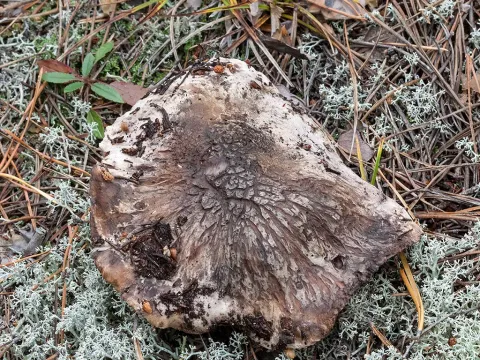
Boletopsis perplexa
Boletopsis perplexa
Boletopsis perplexa is a basidiomycete fungus that acts as a mycorrhizal symbiont rather than a plant pathogen. It is found in association with the root systems of coniferous trees.
What the section contains
Boletopsis perplexa
The fungus forms an ectomycorrhizal network, exchanging essential minerals and water for carbohydrates produced by the tree through photosynthesis.
The fruit bodies are distinct, typically featuring a greyish to brown cap and a pore-bearing surface. The appearance of these bodies is often episodic and dependent on environmental stability.
Biologically, it plays a vital role in forest soil ecology, helping to decompose organic matter and facilitating nutrient uptake for host trees.
Recent taxonomic studies have clarified its distinction within the Boletopsis genus, emphasizing its unique role in forest biodiversity.
The fungus thrives in undisturbed coniferous forests where soil acidity and moisture levels remain consistent. It is highly sensitive to changes in soil chemistry.
A thick layer of forest litter is essential to protect the mycelium from desiccation and sudden temperature drops throughout the year.
The presence of host trees like pine or spruce is a prerequisite for its development. Without these partners, the fungus cannot survive or fruit.
Environmental conditions must be stable, as pollution or significant habitat disturbance can lead to the local extinction of this fungal species.
Proper water drainage in the soil is also important to prevent the degradation of the delicate mycorrhizal hyphae during wet seasons.
Boletopsis perplexa does not pose any harm to agricultural crops or forestry plantations. It is a beneficial organism that contributes to forest health.
It does not cause rot or wilting. On the contrary, its presence is a marker of an ecosystem that is functioning in a natural, balanced state.
There are no known reports of it acting as a pest or a disease agent, as its life cycle is fully integrated into the symbiosis with host trees.
The species provides significant ecological value by stabilizing soil and assisting tree growth in nutrient-poor forest environments.
Since it causes no damage, there is no need for control measures; instead, conservation efforts focus on maintaining the forest habitats where this fungus grows.
- Avoid the use of synthetic fungicides in forest areas to protect sensitive mycorrhizal species.
- Maintain the integrity of the forest floor by preventing excessive soil compaction or litter removal.
- Promote the preservation of old-growth stands that host established fungal communities.
- Monitor the environmental health of forests to ensure the continued survival of beneficial fungi.
- Limit industrial pollution and chemical drift in areas known for high fungal diversity.