
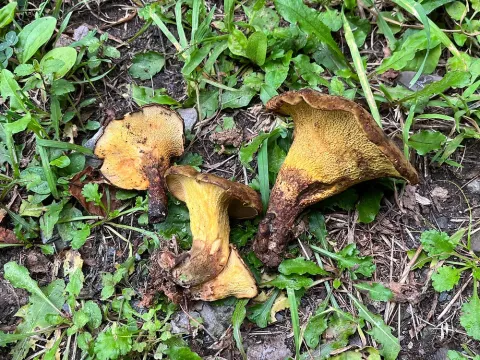
Boletinellaceae
Boletinellaceae
Boletinellaceae is a family of fungi belonging to the order Boletales within the phylum Basidiomycota. It is crucial to clarify that this object is not a plant pathogen and does not cause diseases in agricultural or ornamental crops.
What the section contains
Boletinellaceae
Systematically, this family includes fungi that possess specific morphological characteristics of their fruiting bodies. The most prominent member of this group is Boletinellus merulioides.
The biology of these fungi is closely linked to mycorrhizal interactions within forest ecosystems. They develop in symbiosis with the roots of various woody species, aiding in the mineral nutrition of the plants.
Unlike parasitic fungi, Boletinellaceae do not attack living plant tissues to obtain nutrients. Their life cycle relies on soil saprotrophic nutrition or ectomycorrhizal associations.
Scientific study of the family allows for a better understanding of soil microbiomes. These fungi serve as important indicators of the health of forest soils and the overall biological productivity of forest ecosystems.
For optimal development, members of this family require a temperate climate with sufficient soil moisture levels.
The mycelium of Boletinellaceae spreads most actively in environments featuring leaf litter and woody debris.
The optimal soil acidity for these fungi typically falls within the slightly acidic range, which is characteristic of forest soils.
The development of fruiting bodies occurs primarily during the summer and autumn months when temperatures stabilize between +15 and +22 degrees Celsius.
In agricultural systems, this species is found very rarely, as it requires the specific conditions of a forest biocenosis and the presence of associated host trees.