
Powdery mildew of crucifers
Erysiphe cruciferarum
Description
Symptoms
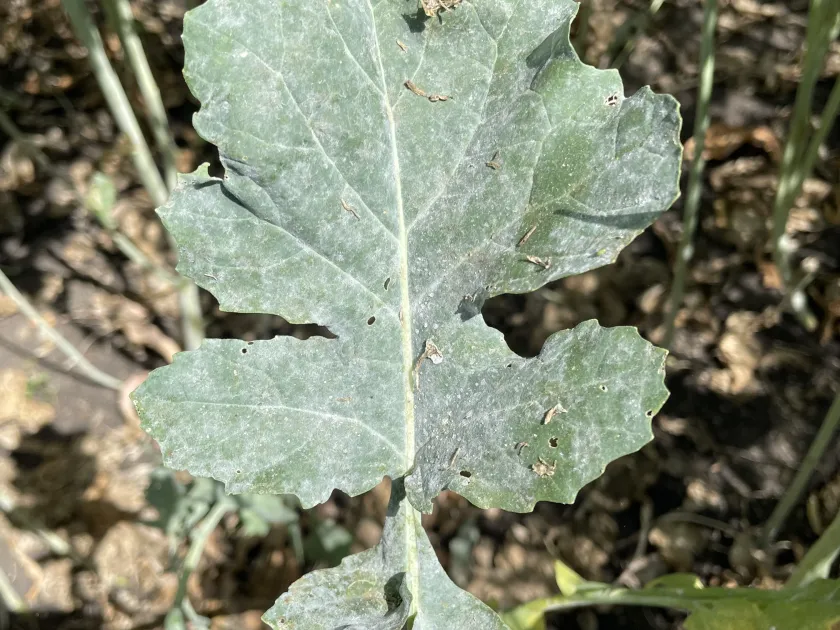
The first symptom is the appearance of a white or grayish-white, spider-web-like growth on the surface of the leaves. As the disease progresses, these patches expand and merge across the leaf blade.
Over time, the growth becomes dense and powdery. The plant tissue underneath starts to yellow and eventually turns brown, leading to necrosis of the affected leaf areas.
Severe infestations lead to premature wilting and death of leaves. Lower foliage is typically affected first, with the disease gradually moving upwards to younger leaves.
Young plants infected early in the season show stunted growth. In cabbage, this hinders the development of the head, making it undersized or entirely deformed.
On mature stages of the infection, tiny black dots may appear within the white powdery growth; these are cleistothecia, indicating the fungus is ready to overwinter.
Pathogen
The causative agent of the disease is an obligate parasite, the fungus Erysiphe cruciferarum. This pathogen belongs to the Ascomycetes class and feeds on plant nutrients through specialized structures called haustoria.
The fungus overwinters as mycelium on plant debris or in the form of cleistothecia, which are small fruiting bodies capable of surviving in the soil and on seeds. In spring, these produce ascospores that initiate primary infections in young crops.
The disease affects a wide range of Brassicaceae family members. Susceptible crops include all varieties of cabbage, radish, rapeseed, mustard, turnip, and various weeds that act as disease reservoirs.
The pathogen spreads through conidia, which are easily carried by wind over long distances. High reproduction rates allow the fungus to complete several life cycles during a single growing season.
Biological features of the fungus allow it to thrive in diverse environments, making it a persistent threat to commercial and home garden vegetable production.
Conditions for development
The ideal temperature for the development of the pathogen ranges from +18 to +25 degrees Celsius. Within this window, conidia production reaches its maximum intensity.
High relative humidity, particularly when coupled with alternating drought and rainfall, provides the perfect moisture level for spore germination on the plant surface.
Overcrowded plantings with poor air circulation are highly susceptible to outbreaks. Reduced ventilation creates a humid microclimate that favors rapid fungal colonization.
Excessive nitrogen fertilization, which forces succulent, rapid leaf growth, often results in lowered plant immunity, making the crops more vulnerable to fungal pathogens.
Neglecting crop rotation and failing to remove infested plant residues are critical factors that contribute to a high inoculum load in the soil for the following season.
Why it matters
The damage caused by the disease is primarily due to the reduction of the leaf surface area available for photosynthesis, which stunts plant development and decreases total yield.
In cabbage crops, powdery mildew results in loose, poor-quality heads that lose marketability and have a significantly reduced shelf life during storage.
Root crops like radishes suffer from premature leaf senescence, which prevents proper nutrient accumulation in the roots, affecting their size and taste.
On rapeseed farms, severe infection can cause losses of up to 50% of the yield due to damage to pods and the premature shedding of seeds.
Moreover, plants weakened by powdery mildew are significantly more prone to secondary infections, such as bacterial soft rot, which further threatens the viability of the crop.
Protection
The most important agrotechnical strategy is strict crop rotation, ensuring that cruciferous vegetables are not planted on the same plot for at least 3-4 years.
Removing all plant debris after harvest and practicing deep plowing help to eliminate primary infection sources from the field.
Choosing resistant cultivars and hybrids is highly recommended as a primary preventive measure, alongside using certified, disease-free seed material.
Chemical control involves the application of appropriate fungicides from the triazole or strobilurin groups at the first sign of visible symptoms.
- Consistent weed management to remove alternative hosts.
- Optimizing plant spacing to ensure better air movement and sunlight penetration.
- Balanced mineral nutrition, focusing on adequate phosphorus and potassium levels.
Discussion
No discussions yet — be the first.